
Building Your Family Legacy: Crafting a Vision Statement
A family legacy doesn’t happen by accident — it’s built with intention, clarity, and a shared vision. This article walks readers through the process of crafting a Family Vision Statement that anchors values, guides decisions, and strengthens generational identity. From defining your core principles to shaping the future you want your children and grandchildren to inherit, this piece offers a practical, faith‑forward roadmap for families who want to live on purpose and lead with conviction.
MAY 2026SOUND MIND LIVING


There is a distinct cultural lie circulating in modern society that equates "legacy" with an inheritance.
We are told that a legacy is something that happens automatically at the end of a life—a final distribution of assets, a name etched onto a building, or a trust fund passed down to the next generation.
But true legacy isn’t something you leave behind in a will; it is something you actively build at the kitchen table. It is an intentional, daily architecture.
For families across the Phoenix Valley—from the bustling, master-planned neighborhoods of Gilbert and Chandler to the expansive multi-generational homes growing throughout the West Valley—the arrival of summer brings a familiar shift. The relentless pace of school schedules, competitive sports leagues, and extracurricular carpools finally slows down. The blistering triple-digit desert heat forces us indoors, creating a rare and providential window of time.
As conservative parents, we often talk about defending our families from the chaotic, shifting values of the modern world. We worry about the cultural noise filtering through our children's devices, the erosion of traditional values, and the rapid pace of societal distraction. But defense is only half the battle. If your household does not have a clear, offensive strategy for what it stands for, the world will happily dictate what it falls for.
An example from a friend of mine: "In our family we work hard and we play hard"
This summer, don't let the season slip away into a blur of screen time and passive consumption. Take ownership of your household’s trajectory. Here is the operational, step-by-step playbook for couples to sit down, identify their core values, and construct a written Family Vision Statement that anchors their household for generations to come.
The Strategic Necessity of a Household Charter
In the corporate world, no serious leader would attempt to navigate a multi-million-dollar enterprise without a clear mission statement, a set of core values, and a defined strategic vision. Yet, many well-meaning entrepreneurs and professionals expend all their strategic energy building businesses, while leaving the spiritual and cultural development of their own homes entirely to chance. They run their companies like clockwork and their families like a hobby.
A Family Vision Statement is your household’s governing charter. It is a written declaration that defines who you are, how you treat one another, how you handle adversity, and where your household is headed.
When a family lacks a unified vision, individual members default to the path of least cultural resistance. But when a home is anchored by a shared identity, every major decision—from how you spend your financial resources to how you discipline your children and choose your media—becomes instantly simplified. The question shifts from "What do we feel like doing?" to "Does this choice align with who the 'Jones' family is?"
The Summer Family Workshop: A Practical 4-Step Format
Constructing this document shouldn't feel like a rigid, bureaucratic exercise. It should be an inspiring, intentional collaboration between a husband and wife, eventually expanding to include the insights of your children.
Set aside two dedicated evenings this summer—free from phones, work emails, and household distractions—to sit down with a blank legal pad, a fresh pot of coffee, and a commitment to radical intentionality.
Step 1: The Historical Audit (Where Have We Been?)
Before looking forward, look back. Re-anchor yourselves in your shared history and the providential moments that formed your household.
The Prompts: Ask yourselves: What are the defining moments of resilience in our marriage so far? When we look back at our parents and grandparents, what were the virtues worth preserving, and what were the generational cycles we consciously chose to break?
The Goal: Identify the bedrock foundational truths that have kept your marriage steady through seasons of trial, loss, or reinvention.
Step 2: Core Value Isolation (What Do We Stand For?)
Many families value good things, but if you try to stand for thirty different principles, you stand for nothing. You must isolate the non-negotiables. Write down a broad list of virtues—honesty, grit, faith, stewardship, hospitality, individual responsibility, physical discipline, respect for authority—and begin the hard work of editing.
The Strategy: Whittle your list down to 4 to 6 core values that uniquely define your family's distinct calling. If your family is deeply rooted in local service and faith-led activism, Stewardship and Humility might be pillars. If your home is highly entrepreneurial, Grit and Innovation might take center stage.
Define Your Terms: Do not just write down a word like "Integrity." Define what it means in plain English. For example: "Integrity means we do the right thing even when nobody is looking, and we own our mistakes immediately without excuses."
Step 3: Future Forecasting (Who Are We Raising?)
Look at your children—whether you are managing a chaotic household of toddlers, navigating the teenage years, or welcoming three generations under one roof. Your primary job as a parent is obsolescence; you are preparing them to leave.
The Core Question: “What virtues must our children possess by the time they walk out our front door as independent adults?” * The Alignment: If you want to raise resilient kids who understand the value of a dollar, your family vision must explicitly emphasize work ethic and financial discipline over unearned comfort. If you want them to carry a sound mind amidst a culture of anxiety, your vision must prioritize spiritual anchor points over worldly validation.
Step 4: Drafting the Statement
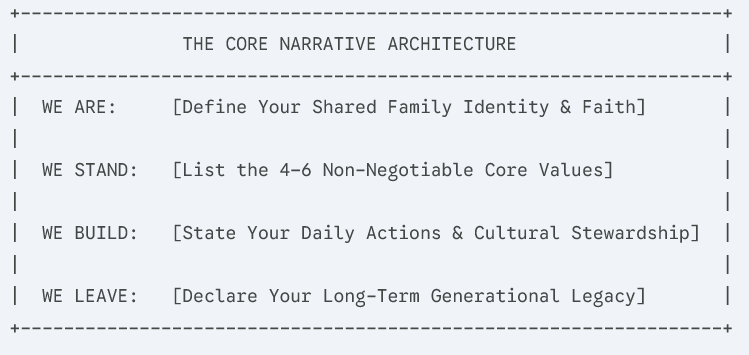
Once you have your history, your core values, and your future goals, it is time to synthesize them into a concise, memorable statement. A great Family Vision Statement can be a single, powerful paragraph, or a set of short, declarative "We Believe" statements.
Stay Salty
Keep the language real, bold, and entirely native to your household's personality. Avoid generic, store-bought slogans. Write something that makes your heart beat faster when you read it aloud.
Moving from Paper to Real Life: Operationalizing the Vision
A vision statement beautifully framed on a living room wall is completely useless if it doesn't translate into daily household habits. True stewardship requires that the document becomes the organic soundtrack of your home.
The Sunday Night Review: Use your vision statement to guide weekly family meetings. Before the chaos of the week begins, gather the flock around the table. Review the schedule, check in on emotional and spiritual health, and call out moments where family members tangibly demonstrated the core values during the week.
The Filter for Adversity: When crisis hits—whether it’s a financial setback, a difficult medical diagnosis, or a localized community disruption like the recent Hazen Wildfire—gather your children and read your statement. Remind them: "This is who we are. We don't panic, we don't despair, and we don't retreat. We rely on our faith, we protect each other, and we face this challenge with a sound mind."
Anchor the Milestone Seasons: As your kids grow, graduate, or face massive life shifts—moments that require the deep emotional mapping discussed in our look at The Psychology of Starting Over—the family vision remains their permanent northern star. It gives them an unshakeable sense of belonging that outlasts any temporary geographical or professional change.
The Grounded Bottom Line
The modern world is structured to pull families apart. Between hyper-individualistic media algorithms, exhausting schedules, and cultural forces that mock traditional authority, the baseline trajectory for the modern household is fragmentation.
If you do not intentionally build a distinct culture inside the walls of your home, the outside culture will happily build it for you.
Legacy isn't a passive byproduct of a long life. It is an active, aggressive, and beautifully conservative act of creation. It is about planting your roots deep into the desert soil, drawing strength from timeless biblical foundations, and building an unshakeable family fortress that can withstand any cultural storm.
This summer, take the time. Sit down with your spouse. Pour the hot-cocoa, pick up the pen, and outline your blueprint. Stop waiting to leave a legacy, and start building one.
Recent Articles
Daily Phoenix © 2026
Daily Phoenix is Arizona’s premium digital magazine for faith‑forward leadership, community resilience, and local governance.
Reframe your inbox
Subscribe to our newsletter and never miss a story.
We care about your data in our privacy policy.