
Capitalizing on the Semiconductor Boom: Opportunities for East Valley Micro-Businesses
The East Valley is sitting on a once‑in‑a‑generation economic surge — more than $265 billion in semiconductor investment reshaping Phoenix, Chandler, Mesa, and beyond. But this story isn’t just about Intel and TSMC’s mega‑projects; it’s about the micro‑business owners asking where they fit in. This piece breaks down the real opportunities hidden inside the boom — from compliance‑ready branding to subcontractor networks, executive relocation spending, and civic‑level influence — giving East Valley entrepreneurs a clear, actionable playbook for capturing their share of the wave. It’s bold, local, and unapologetically strategic.
INNOVATIONBUSINESS AND CAREER BUILDERMAY 2026


Capitalizing on the $265B Boom: How East Valley Micro-Businesses Can Ride the Semiconductor Wave
The desert is reshaping itself. If you drive past the massive construction cranes altering the horizons of North Phoenix, Chandler, and Mesa, you aren’t just witnessing the pouring of concrete; you are watching the relocation of the global technological center of gravity. Between the historic Intel expansion in Chandler and TSMC’s monumental presence just up the road, more than $265 billion in private capital is flooding into the Phoenix metropolitan ecosystem.
For the average corporate executive, these figures are a victory lap for macroeconomic policy. But for the local contractor in Gilbert, the boutique creative agency owner in Mesa, and the family-run commercial cleaner in Chandler, those 11-digit numbers can feel incredibly distant. When a multinational tech giant drops a small nation’s GDP into your backyard, the immediate reaction for a micro-business owner isn’t always optimism—it’s a question: “Where do I fit into this, or am I just going to get squeezed out by the rising cost of living?”
Let’s be entirely real. Multinational corporations do not naturally look to the local five-person operation when filling out massive enterprise supply chains. They rely on established, bureaucratic prime contractors who speak the sterile language of global compliance. But that does not mean the capital stays locked behind corporate gates.
The $265 billion boom isn’t just a semiconductor wave; it is an economic multiplier. For every single tier-one engineer or corporate strategist relocated to the East Valley, a secondary ecosystem of human needs, commercial real estate, corporate hospitality, and specialized infrastructure emerges. The money is coming. The real question is whether East Valley entrepreneurs possess the strategic clarity, the grit, and the institutional agility to position their brands to catch the runoff. There are pros and cons but it is important our neighbors to know where they fit into this.
True conservative stewardship isn’t about waiting for corporate crumbs to fall from the table; it’s about aggressively building the infrastructure locally so that those dollars have no choice but to stay in our communities. Here is the operational playbook for how East Valley micro-businesses can position their brand architecture, elevate their networks, and capture the corporate spending boom.
1. Decode the Enterprise Language: The Compliance Handshake
The biggest barrier preventing an exceptional local service provider—whether a commercial landscaper, an electrical contractor, or a specialized IT firm—from winning corporate accounts isn't a lack of capability. It is a lack of institutional alignment.
Global tech enterprises operate within hyper-rigid risk management frameworks. If your digital footprint looks like a casual neighborhood operation, you are disqualified before a human being ever reads your proposal. To ride this wave, micro-businesses must execute an immediate upgrade to their professional brand architecture.
Get Vendor-Ready Before the Bid: Do not wait for an RFP (Request for Proposal) to land on your desk to figure out your compliance. Large-scale tech operations and their tier-one suppliers look for specific certifications, robust liability insurance structures, and pristine safety records (such as OSHA compliance logs for trade contractors).
The "Digital Handshake" Audit: If an enterprise procurement officer Googles your company, what do they see? A disorganized Facebook page, or a secure, authoritative corporate landing page that clearly defines your capacity, your service territory, and your professional standards? Your digital brand must project the stability of a firm five times your size.
2. Target the Subcontractor Network, Not the Giant
Let’s dismantle a common misconception: a five-person boutique creative agency in Gilbert is likely not going to sign a direct, multi-million-dollar marketing contract with Intel corporate headquarters. Attempting to navigate that front door is a waste of scarce entrepreneurial energy.
Instead, the smart money targets the massive tier-one and tier-two suppliers that move into the region alongside the tech giants. When a semiconductor plant goes live, dozens of chemical logistics firms, specialized tooling manufacturers, and industrial packaging operations open facilities in places like the Mesa digital corridor and Queen Creek.
Map the Ecosystem: These secondary firms are large enough to have substantial budgets, but nimble enough to hire local talent without requiring a year-long global procurement review. They need local signage companies, local commercial real estate brokers, local catering for corporate events, and regional fleet maintenance.
The B2B Pivot: Shift your marketing messaging away from broad consumer appeal and focus heavily on industrial reliability, operational uptime, and local responsiveness. In the semiconductor world, a delay costs millions. If your micro-business can brand itself as the "24/7 localized rapid-response partner" for these suppliers, you become indispensable.
3. Capture the Relocation and Executive Spend
The corporate investment isn’t just importing machinery; it is importing families. Thousands of high-earning professionals, engineers, and project managers are relocating to the master-planned communities of the East Valley. They need homes, private education, premium healthcare, and high-end lifestyle services.
This is where boutique agencies, residential contractors, and upscale service providers can capture immense value.
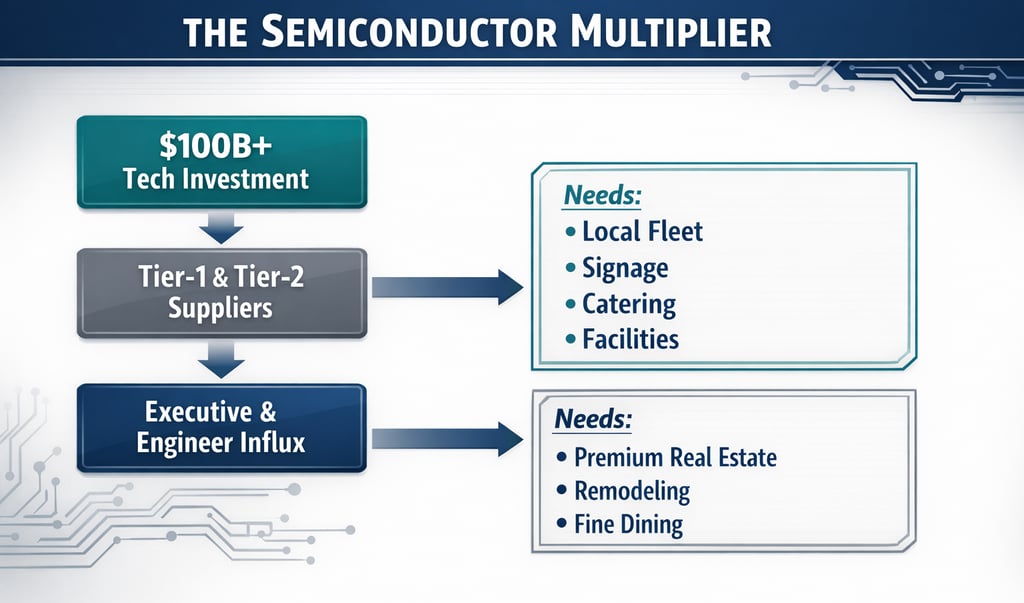

Position for Premium Demographics: If you run a home remodeling business, a residential landscaping firm, or a luxury service brand, your target audience in the East Valley is expanding exponentially. Tailor your brand to speak to the values of precision, longevity, and premium craftsmanship that appeal to an analytical, engineering-minded demographic.
Hyper-Local Collaboration: Micro-businesses should form strategic alliances. A boutique interior designer in Gilbert, a local moving and storage company, and an independent real estate broker should unify their professional networks to create a seamless "Executive Relocation Package." By combining forces under a shared umbrella, you out-navigate the slow-moving national relocation conglomerates.
4. Operationalize Local Networking and Civic Advocacy
In a world increasingly dominated by detached, digital-first interactions, local business is still accelerated by real, face-to-face trust. The East Valley possesses a uniquely collaborative, pro-business civic infrastructure, but it requires active participation.
Show Up Where Decisions Are Made: Do not neglect local planning committees, town council budget meetings, and regional economic development groups. When projects like Mesa's tech expansions or Gilbert's infrastructure developments are debated, the micro-business owners who show up to offer informed, data-driven public commentary are the ones who build relationships with city planners and developers.
Leverage the 602 and 480 Synergy: Events highlighting local entrepreneurship are prime real estate for networking. Use these spaces not just to sell to consumers, but to build partnerships with fellow business owners. Your next major corporate lead will likely come from a referral from another local business owner who didn't have the capacity to handle a specific contract.
The Grounded Bottom Line
The $265 billion technological transformation of the East Valley can be viewed through two distinct lenses. You can view it with anxiety, watching the changing landscape and worrying that the scale of global capital will drown out the independent spirit that made Arizona great in the first place. While many of these concerns are valid, you can also view it as a historic economic frontier—a massive influx of capital that can be actively mined by local entrepreneurs who refuse to think small.
Capitalism at its best isn't about the supremacy of the multinational giant; it is about the resilience, adaptability, and quiet strength of the independent business owner who knows their community better than any out-of-state corporate board ever could.
The semiconductor wave is here, and it is reshaping the desert. Upgrade your brand architecture, align your compliance, target the secondary ecosystem, and claim your stake in the East Valley boom. The capital is waiting; it’s time to go build.
Last Updated [August 18, 2026]
Recent Articles
Daily Phoenix © 2026
Daily Phoenix is Arizona’s premium digital magazine for faith‑forward leadership, community resilience, and local governance.
Reframe your inbox
Subscribe to our newsletter and never miss a story.
We care about your data in our privacy policy.