
Beyond the Ballot Box: Crafting Effective Public Comments for Your Village Planning Committee
Public influence doesn’t end on Election Day — it begins in the rooms where development plans, zoning changes, and neighborhood priorities are shaped. This article gives residents a practical, empowering guide to writing public comments that actually move the needle inside Phoenix’s Village Planning Committees. From understanding how these committees operate to crafting clear, persuasive statements that cut through bureaucratic noise, this piece shows everyday citizens how to show up, speak up, and shape the future of their community with confidence and credibility.
MAY 2026THE CITIZEN & THE ACTIVIST


Understanding the Importance of Public Comments
Beyond the Ballot Box: How to Write an Effective Public Comment for Your Village Planning Committee
Every few weeks, in municipal chambers and school cafeterias across the Phoenix Valley—from Maryvale to the East Valley—a familiar, frustrating ritual plays out. A controversial zoning change, a high-density housing proposal, or a massive infrastructure variance comes before a local village planning committee or town council. The room fills to capacity. Citizens, rightfully concerned about the character, safety, and property values of their neighborhoods, wait hours for their turn at the microphone.
When their name is finally called, they have exactly three minutes.
What happens next is usually a tragedy of misdirected energy. Driven by justifiable frustration, the resident spends their 180 seconds venting general grievances. They talk about the state of the nation, express vague anger at "greedy developers," or launch emotional appeals about the changing world. The timer beeps, the gavel falls, and the committee members offer a polite nod before voting exactly how they intended to before the meeting started. The citizens leave feeling ignored, convinced that the system is entirely rigged.
Though municipal bureaucracy certainly has its vices we need to be sure we are speaking their language. This advice is practical throughout all civic arenas.
In our primer on Civic Engagement 101: Getting Involved in Your Local Planning Committees, we established that real power in local government resides in the unglamorous, bureaucratic micro-milestones where neighborhoods are actually shaped. True conservative activism isn't about standing on a corner with a megaphone or screaming into the digital void of social media; it is about the disciplined, data-driven stewardship of your local community.
Showing up angry but uninformed is a failure of strategy. If you want to actually defeat a bad development, preserve neighborhood density, or protect local resources, you must move beyond the ballot box and master the art of the highly effective public comment. Here is your step-by-step masterclass in municipal micro-activism.
1. Intelligence Gathering: How to Read a Zoning Map and Staff Report
Before you ever draft a single word of your testimony, you must understand the rules of the game being played. Planning committees do not vote based on raw emotion or abstract political philosophy; they vote based on municipal codes, general plans, and legal definitions.
The most potent weapon in a citizen activist’s arsenal is not a protest sign—it is the official Staff Report, which is made publicly available on your municipality's legislative portal a few days before any public hearing.
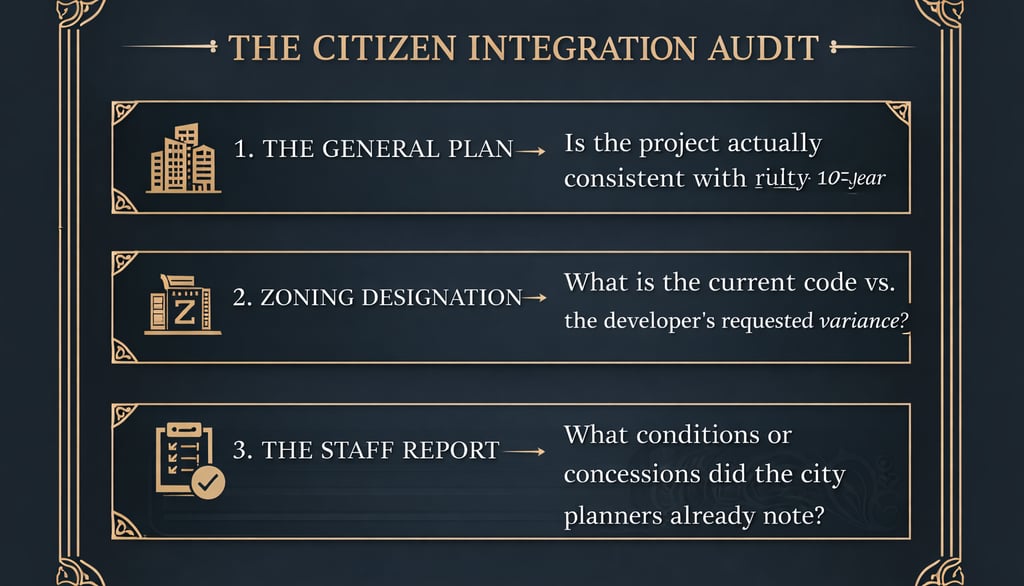
Decode the Zoning Abbreviations: When a developer wants to alter a neighborhood, they are typically asking for a Rezone or a Special Use Permit. You must look at the current zoning map. If an area is zoned R-1-35 (Single-Family Residential, minimum 35,000-square-foot lots) and a developer wants to shift it to a high-density multi-family designation to build apartment complexes, that is your primary leverage point.
Audit the General Plan Consistency: Every municipality operates under a voter-approved General Plan—a long-term blueprint for growth. Look at the land-use map in that document. If the developer’s project contradicts the explicit, long-term vision established by the citizens, you have a massive structural argument. Committees hate voting for projects that open the municipality up to legal challenges for violating their own General Plan.
2. Deconstructing the 3-Minute Clock: The 180-Second Blueprint
Three minutes sounds incredibly brief, but in the hands of a disciplined communicator, it is enough time to dismantle a flawed proposal. The secret is ruthless editing. You cannot cover the history of western civilization and the price of gas in 180 seconds. You must structure your speech with the precision of a legal brief.
Here is the exact structural architecture of a high-converting, three-minute public comment:
0:00–0:30 | The Grounded Introduction
State your name, your specific neighborhood or cross-streets, and your exact position on the agenda item immediately. Do not beat around the bush.
"Good evening, Chairman and committee members. My name is [Your Name], and I live in the residential corridor directly adjacent to the proposed development. I am here tonight to formally urge this committee to vote NO on Agenda Item #4."
0:30–1:30 | The Data-Driven Core (The "Why")
This is where 90% of citizens fail. Do not say, "This project will bring too much traffic and ruin our town." Instead, cite specific, verified data points from the staff report, independent traffic studies, or water capacity metrics.
"According to the city’s own engineering assessment, this specific rezone will add an estimated 1,200 daily vehicular trips to a standard two-lane corridor that already operates at a Level of Service D. Furthermore, our local elementary school is currently at 96% capacity, and this proposal provides zero capital infrastructure funding to mitigate classroom overcrowding."
1:30–2:30 | The Precedent and Policy Alignment
Tie your argument directly back to existing municipal codes or recent precedent. Show the committee that voting against this project is the only logically consistent choice based on their past actions. This approach mirrors the defensive oversight citizens had to deploy during local battles like the Harvest Grove Project, where hyper-local density compromises had to be manually extracted through rigorous community input.
"Section 4.2 of our Town Code explicitly states that low-density buffers must be maintained between commercial zoning and established single-family homes. This project offers a mere 10-foot setback, completely violating the spirit and letter of that protection."
2:30–3:00 | The Actionable Alternative
Never just be the person who says "no." Be the person who proposes a viable, conservative path forward based on responsible stewardship.
"We welcome commercial investment in our town, but it must align with our established infrastructure limits. I urge this committee to deny this rezone and request that the developer return with a plan that conforms to our existing R-1 guidelines. Thank you for your time and your service to our community."
3. Operationalizing the Room: The Power of Coordination
An individual citizen speaking brilliantly at the microphone is an asset; a coordinated, disciplined group of citizens deploying distinct, non-overlapping arguments is an unstoppable civic force.
If you are organizing your neighbors to protect a local corridor, do not let twenty people show up to repeat the exact same emotional statement. The committee will tune out by speaker number three. Instead, treat your neighborhood group like a strategic task force.
Assign Specialized Pillars: Divide the core arguments among your neighbors based on their real-world expertise. Have a local real estate professional speak exclusively on the property value metrics. Have an engineer or commuter focus entirely on the traffic gridlock data. Have a parent highlight the school capacity and pedestrian safety concerns near local crosswalks.
Visual Synergy: If your group is opposing a major rate hike—similar to the organized local pushback seen in the Gilbert Water Rate Debate—make your presence felt visually without causing chaos. Have everyone wearing a unified color or standing silently when your primary speaker takes the microphone. It signals to the committee that the room isn’t filled with isolated eccentrics, but with a unified block of taxpayers who vote.
Frequently Asked Questions
How many minutes do I have to speak during a public comment at a Phoenix Village Planning Committee meeting?
Residents typically have exactly three minutes to address the committee. Because time is strictly enforced, structuring your remarks with a focused, data-driven approach is critical.
What is the most important document to review before opposing a local development?
The official Staff Report—released on your municipality's legislative portal a few days before the hearing—is your most powerful tool. It contains the official analysis, engineering assessments, and code references needed to build a credible argument.
How do zoning designations like R-1-35 impact my neighborhood?
Zoning codes dictate how land can be used. For example, a designation like R-1-35 typically means Single-Family Residential with a minimum lot size of 35,000 square feet. Developers requesting high-density multi-family re-zones are often in direct conflict with these existing protections.
What is the General Plan, and how can I use it in my public comment?
Every municipality operates under a voter-approved General Plan that outlines long-term growth and land-use blueprints. Highlighting that a proposed development contradicts the city's own explicit long-term vision creates a strong structural argument against the project.
Is it better to speak individually or coordinate with neighbors?
Coordinated groups have a much higher impact than isolated speakers. By dividing specialized pillars among your neighbors—such as traffic data, school capacity metrics, and property value impacts—you present a disciplined, professional case rather than generic frustration.
The Grounded Bottom Line
It is incredibly easy to sit at home, look at national headlines, and sink into a state of political cynicism. But national politics is largely a spectator sport designed to generate outrage and fundraising clicks. Local government, however, is a game of inches where ordinary citizens can still win massive victories if they bother to learn the playbook.
True conservatism is built on the foundation of local self-governance. When we abdicate our seats at village planning meetings, we hand the keys of our communities over to highly paid corporate lobbyists and career bureaucrats who do not sleep in our neighborhoods, raise their children in our schools, or care about the long-term stewardship of our desert landscape.
Pick up the staff report. Study the zoning maps, practice your three-minute clock, and step up to the microphone with absolute confidence and data-driven precision. The future of your neighborhood isn’t decided at the ballot box once every two years—it is decided in the committee rooms every single week. Go claim your three minutes.
Recent Articles
Daily Phoenix © 2026
Daily Phoenix is Arizona’s premium digital magazine for faith‑forward leadership, community resilience, and local governance.
Reframe your inbox
Subscribe to our newsletter and never miss a story.
We care about your data in our privacy policy.