
From Tree to Table: Reviving the Art of Harvesting Arizona’s Native Mesquite
Discover the desert's hidden bounty. From historical significance to modern culinary uses, learn why the native mesquite is the ultimate local superfood and how you can harvest it right in your own backyard
JULY 2026THE TABLE


Introduction to Mesquite Harvesting
In the sun-drenched landscapes of the Phoenix metropolitan area, we often view our environment through the lens of aesthetic choices: the manicured palm, the decorative citrus, or the functional desert-adapted shrub. But hidden in plain sight, standing as a silent sentinel of the Sonoran Desert, is one of the most culturally significant and nutritionally dense plants in North America: the mesquite tree.
For many Valley residents, the mesquite is often dismissed as a "messy" tree—one that sheds leaves and litters sidewalks with brown, curled pods. Yet, to look at a mesquite tree and see only debris is to miss out on a legacy that sustained the people of the Gila River and Salt River valleys for thousands of years. It is time we reframe our relationship with this desert giant. The mesquite is not just a tree; it is an abundant, free, and hyper-local superfood waiting right in our own backyards.
The Bread of Resilience: A Valley History
To understand the importance of mesquite, we must look back at the historical footprint of the Valley of the Sun. Before the rise of sprawling suburbs and the introduction of industrial agriculture, the Sonoran Desert was a managed landscape. The indigenous peoples of this region, including the O’odham, utilized the mesquite bosque—the dense, forest-like groves found along riverbanks—as a vital grocery store and pharmacy.
Mesquite provided almost everything necessary for survival: durable wood for construction and fuel, sap for medicine, and perhaps most importantly, the pods. These pods were gathered in massive quantities, stored, and ground into meal. In many ways, mesquite was the "bread of the desert," a staple crop that required no irrigation and thrived in the harsh, high-heat conditions that defined the Phoenix basin long before modern air conditioning.
Today, those historic groves have been significantly reduced by urban development, but the trees remain embedded in our landscape. From the mesquite-lined corridors of the East Valley to the rugged foothills surrounding Phoenix, these trees are a testament to our region's natural resilience.
Identifying Your Backyard Bounty
If you are ready to engage in the "lost art" of harvesting, the first step is identification. Not all mesquites are created equal, and while most produce edible pods, understanding the varieties will enhance your culinary experience.
The Three Main Players
Velvet Mesquite (Prosopis velutina): This is the most common native species in the Phoenix area. You can identify it by its soft, velvety leaves. The pods are generally long and provide excellent, sweet flour.
Honey Mesquite (Prosopis glandulosa): Often found in similar environments, its pods are also highly prized. They tend to be slightly more slender but carry a rich, honey-like sweetness when fully dried.
Screwbean Mesquite (Prosopis pubescens): Distinguishable by its unique, tightly coiled pods that look like wood screws. These are less common in residential landscaping but are highly sought after by foragers for their distinct, intense flavor.
A Note on Safety: Always ensure you are harvesting from trees that have not been sprayed with herbicides or pesticides, and avoid trees directly adjacent to high-traffic roads to minimize pollutants.
The Harvest: Timing and Technique
The harvest window is relatively short and dictated by the heat. In the Phoenix Valley, late summer—typically July through early September—is the prime time for collection.
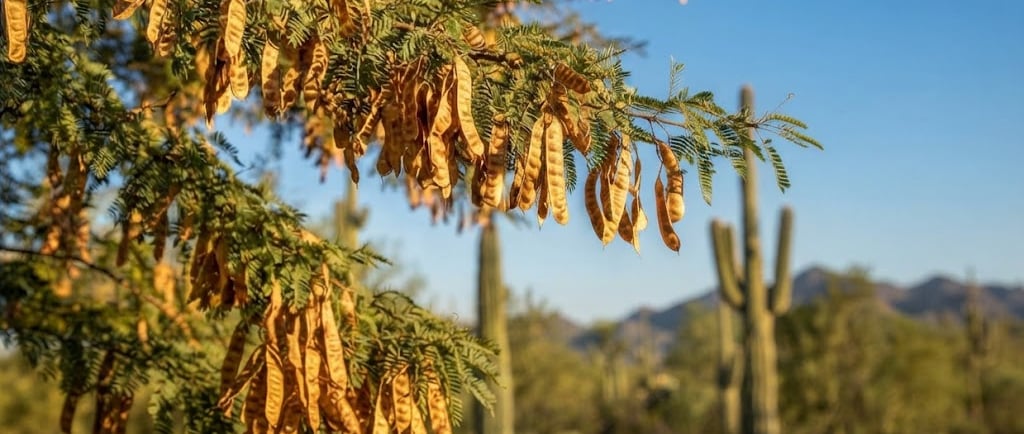
You aren't looking for the green, immature pods; you want the ones that have ripened on the tree. Look for pods that have turned a light tan or straw color, are dry to the touch, and snap easily. If the pod is still flexible or slightly green, it needs more time to cure on the branch.
Pro Tip: Don’t wait for them to fall to the ground. Once they hit the soil, they are susceptible to mold and moisture. Harvest by hand, snapping the dry pods directly from the branches into a basket or cloth bag.
From Pod to Pantry: Processing
Once you have your haul, the real work begins—and it is a labor of love.
Drying: Spread your pods out in a single layer on a screen or a clean sheet in a hot, dry area (a garage or a patio table in the sun works perfectly). They need to be bone-dry. If they have any moisture left, they will not grind properly.
Cleaning: Sift through your pods to remove any stems, leaves, or debris.
Grinding: This is where things get interesting. You cannot simply throw a whole mesquite pod into a standard kitchen blender—you will ruin the blades. Commercial-grade mills are often used, but at home, many foragers use a heavy-duty grain mill or a dry-grind attachment. Some even use a clean mortar and pestle for smaller batches. The goal is to separate the sweet, fibrous pulp from the hard, inedible seed.
Sifting: After grinding, use a fine-mesh sieve to separate the fine, tan-colored flour from the fibrous bits. The resulting powder is pure desert gold.

The Culinary Superfood
Why go through the effort of harvesting and grinding? Because mesquite flour is a culinary powerhouse.
The Flavor Profile
Mesquite flour is inherently complex. It doesn't taste like wheat or almond flour; it carries deep, earthy notes of molasses, caramel, and a hint of smoke. It is naturally sweet, meaning you can often reduce the amount of added sugars in your recipes.
"Mesquite is not just a tree; it is an abundant, free, and hyper-local superfood waiting right in our own backyards."
Nutritional Powerhouse
Beyond the flavor, mesquite is a low-glycemic superfood. It is packed with protein, calcium, and magnesium, and because it is absorbed slowly by the body, it doesn't cause the blood sugar spikes associated with processed white flour. For those of us living in a culture of refined carbohydrates, replacing even 25% of your flour with mesquite can significantly boost the nutritional profile of your favorite treats.
In the Kitchen
Start small. Because mesquite flour is gluten-free, it doesn't hold structure on its own. Use it as an additive:
Morning Rituals: Add two tablespoons to your pancake or waffle batter for a deep, nutty complexity.
Baking: Replace a portion of the flour in your favorite banana bread or muffin recipe with mesquite.
Savory Applications: Don’t limit yourself to sweets. The natural smokiness makes it an incredible rub for grilled meats or an addition to chili.
Reclaiming Our Roots
Harvesting mesquite is more than just an exercise in gathering free food; it is an act of connection. In a world of global supply chains and sanitized grocery aisles, taking the time to harvest a native plant from your own neighborhood reminds us that we live in a functioning, generous ecosystem.
When you bake with mesquite, you aren't just making muffins—you are participating in a tradition that spans centuries. You are honoring the history of the Valley, acknowledging the resilience of the Sonoran Desert, and bringing a "bold and real" piece of Arizona right to your table.
So, this summer, keep an eye on the trees in your neighborhood. When you see those golden, drying pods, don't walk past them as if they are trash. See them as a gift from the desert, ripe for the taking, and join the growing movement of Phoenicians who are rediscovering the incredible, sustainable bounty of our own backyard.
Recent Articles
Daily Phoenix © 2026
Daily Phoenix is Arizona’s premium digital magazine for faith‑forward leadership, community resilience, and local governance.
Reframe your inbox
Subscribe to our newsletter and never miss a story.
We care about your data in our privacy policy.