
Building a Local Networking Strategy: A Tactical Guide for Brand Growth in Gilbert and Chandler
Master local networking in the East Valley with this tactical guide. Learn how to leverage Gilbert and Chandler’s unique business climates to build lasting professional authority and trust.
JULY 2026BUSINESS AND CAREER BUILDER


Understanding the Importance of Local Networking
In an era dominated by algorithmic feeds, targeted digital ad spend, and remote communication tools, the digital landscape is increasingly crowded. For entrepreneurs, independent authors, and local business owners, the instinct is often to pour more energy into online optimization. Yet, true market authority and lasting professional trust are frequently forged in the physical world.
If you operate in the Phoenix East Valley—specifically within the bustling, entrepreneurial ecosystems of Gilbert and Chandler—offline networking is not merely a supplemental marketing tactic; it is a foundational growth pillar. Local commerce thrives on proximity, reputation, and face-to-face rapport.
This comprehensive tactical guide explores how to leverage local Chambers of Commerce, community events, and civic gatherings to build an unshakeable offline professional brand without wasting your most valuable asset: time.
1. The Power of Place: Understanding the East Valley Business Climate
Before walking into a room, you must understand the dynamics of the room itself. The Gilbert and Chandler micro-economies are unique. They combine the rapid, tech-driven innovation of the "Silicon Desert" with the tight-knit, community-centric values of a traditional hometown.
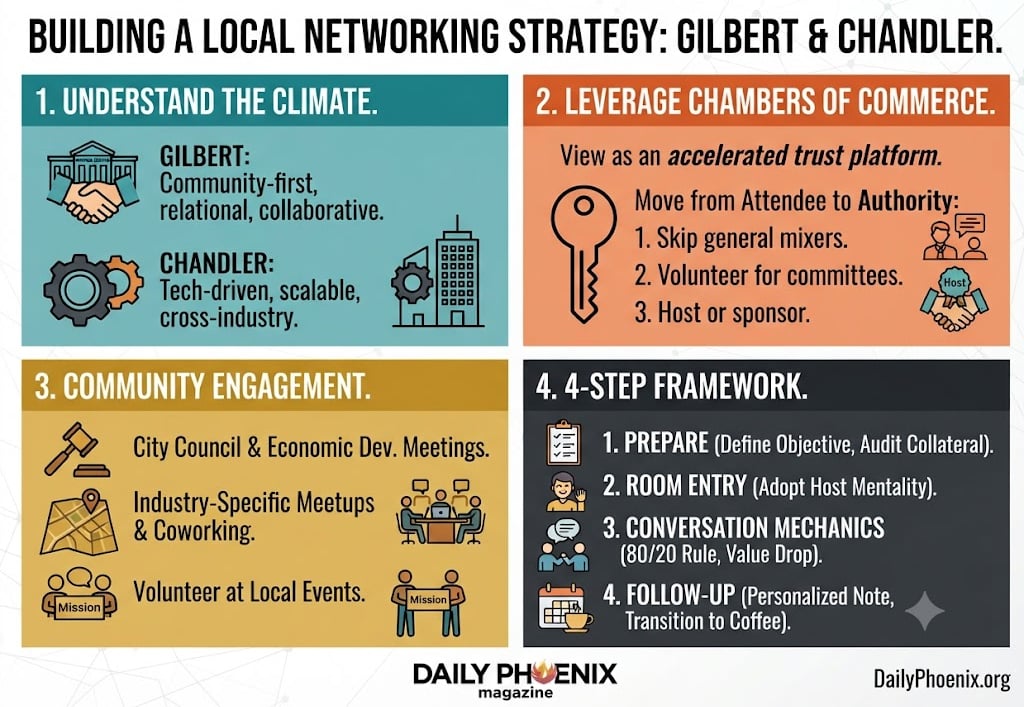
Gilbert: Known for its vibrant Heritage District, family-oriented growth, and a high concentration of independent service providers, consultants, and creative professionals. Networking here often feels community-first, relational, and deeply collaborative.
Chandler: Characterized by a robust tech corridor, aerospace manufacturing, biomedical innovation, and massive corporate headquarters alongside a booming small business community. Networking in Chandler leans slightly more corporate, scalable, and cross-industry.
Operating across this corridor requires a dual approach. You need the relational warmth favored in Gilbert paired with the scalable strategic vision valued in Chandler. Offline networking bridges this gap by replacing digital anonymity with a handshake, a voice, and a physical presence.
2. Demystifying the Chamber of Commerce: Quality Over Quantity
The local Chamber of Commerce is often misunderstood. New entrepreneurs view it as a stagnant social club of card-swappers, while cynical veterans write it off as an expense with a low direct ROI.
Both views miss the mark. A Chamber is not a direct sales channel; it is an accelerated trust platform.
Choosing Your Arena: Gilbert vs. Chandler
While you can join multiple chambers, focus your initial energy where your target audience, client base, or collaborative partners reside.
The Gilbert Chamber of Commerce excels at community connectivity, local spotlight events, and small business advocacy.
The Chandler Chamber of Commerce offers massive multi-industry mixers, large-scale community awards, and high-level economic development roundtables.
The Chamber Playbook: How to Move from Attendee to Authority
Simply paying dues and attending an occasional morning mixer yields nothing. To build a brand, treat the Chamber like an institutional ecosystem:
Skip the General Mixers First: While evening mixers (often called "Business After Hours") are popular, they can be loud and superficial. Instead, start with morning educational seminars, ribbon cuttings, or ribbon-cutting committees. These smaller environments allow for substantive conversation rather than transactional elevator pitches.
Volunteer for Committees: The fastest way to establish authority is through contribution. Join an event committee, a workforce development task force, or a young professionals group. Working side-by-side on a tangible project reveals your competence and reliability far better than any 30-second introduction.
Host or Sponsor Smartly: Once your budget permits, host a morning coffee connection at your office, or co-sponsor an educational workshop. Positioning yourself as the educator rather than the vendor completely shifts how potential clients perceive you.
3. Beyond the Chamber: High-Value Community Events in the East Valley
While the Chamber is your institutional anchor, the broader Gilbert and Chandler community is packed with alternative venues where professional brands are quietly built.
A. Economic Development and City Council Meetings
Civic engagement is an underutilized networking goldmine. Attend Gilbert Town Council meetings, Chandler Chamber economic forecasts, or urban planning open houses.
Why it works: You meet with local developers, city officials, prominent real estate investors, and civic leaders. These individuals are decision-makers who care deeply about the trajectory of the region. Being present signals that you are invested in the community's future, not just your own balance sheet.
B. Industry-Specific Meetups and Coworking Hubs
The East Valley features exceptional coworking spaces and incubators (such as those in downtown Gilbert or near Chandler’s Price Road corridor).
Tactical Tip: Look for specialized groups focusing on tech innovation, creative arts, real estate syndication, or women in business. These niche groups filter out the noise, ensuring that the people you meet share your specific professional vocabulary and challenges.
C. Local Cultural, Charity, and Volunteer Events
Nothing tests and proves character like shared manual labor or community service. Whether you are volunteering at a local food bank packing event, participating in a downtown Gilbert heritage cleanup, or supporting a Chandler youth initiative:
The Mindset Shift: Never network with a pitch deck in your pocket while volunteering. Instead, focus entirely on the mission. The most enduring professional relationships and referral partnerships are born when two professionals realize they share the same core values while working side-by-side for a common good.
4. The 4-Step Offline Networking Framework
Showing up is only ten percent of the battle. What you do before, during, and after the event dictates whether you build a brand or become background noise.
Step 1: Pre-Event Preparation
Define Your Objective: Are you looking for strategic partners (e.g., CPAs connecting with financial advisors), direct clients, or mentors? Know your goal before walking through the door.
Audit Your Collateral: Ditch cheap paper business cards that end up in the recycling bin. Invest in a clean, modern card featuring clear branding, your core digital hub, and a distinct hook. Alternatively, use a digital NFC business card for seamless mobile transfers, but always have a physical backup.
Step 2: The Art of the Room Entry (Mastering the First 10 Minutes)
Arrive Early, Not Late: Arriving 10 minutes early allows you to settle in, chat calmly with the event organizers (who know everyone in the room and can act as valuable connectors), and avoid the awkwardness of trying to break into pre-formed circles.
Adopt the Host Mentality: Pretend you belong there and that your job is to make others feel welcome. Approaching a stranger with the mindset of "How can I help you enjoy this event?" instantly disarms people and neutralizes networking anxiety.
Step 3: Conversation Mechanics
The 80/20 Rule: Let the other person talk 80% of the time. Ask open-ended questions that uncover their current business pain points or local projects. Good examples include:
"What is the biggest operational hurdle your business is facing in the East Valley right now?"
"What brought you out to this specific event tonight?"
"How has your business adapted to the growth happening across Gilbert and Chandler over the last year?"
The Value Drop: When it is your turn to speak, avoid reciting a robotic elevator pitch. Instead, offer a relevant insight, a helpful resource, or an introduction to someone else in your network who could solve their specific problem. Give first; reputation follows.
Step 4: The 48-Hour Follow-Up Protocol
The fortune is in the follow-up, yet 90% of networkers fail here. Within 48 hours of the event:
Send a Personalized Note: Connect on LinkedIn with a customized message referencing a specific detail from your conversation (e.g., "Great meeting you at the Chandler mixer. Hope that zoning meeting goes well on Thursday!").
Fulfill Promises Immediately: If you promised an article, a contact introduction, or a book recommendation, send it immediately. Reliability is the rarest and most magnetic brand trait you can possess.
Transition to Coffee: Move high-potential connections out of the networking event environment and into a 20-minute coffee meeting at a local spot (such as a coffee shop in Gilbert's Heritage District or downtown Chandler) to explore deep alignment.
5. Avoiding Common Networking Pitfalls
Even well-intentioned professionals frequently sabotage their offline branding efforts through avoidable missteps:
The Pitch-Slap: Handing someone your business card and immediately launching into a high-pressure sales pitch before learning their name. This guarantees your card goes straight into the trash.
The Wallflower Trap: Hiding in the corner with your smartphone to avoid social awkwardness. If you feel nervous, volunteer to help the registration desk; it forces you to interact naturally with every single person who walks in.
Transactional Fatigue: Treating people purely as leads rather than human beings. People can smell commission breath from across the room. Focus on building friendships; commerce will naturally follow trust.
6. Measuring Your Offline ROI
How do you know if your offline networking strategy is working? Unlike digital marketing, where clicks and conversions are tracked via pixels, offline ROI is measured in compounding relational equity.
Track these qualitative and quantitative metrics quarterly:
Warm Introductions Received: How many times did a contact think of you and connect you to a client without you asking?
Collaborative Opportunities: Did your offline presence result in co-authored articles, joint ventures, or speaking engagements?
Local Brand Recognition: When you walk into local business gatherings, do people recognize your name, associate you with your specific expertise, and welcome you into conversations organically?
"A Chamber is not a direct sales channel; it is an accelerated trust platform."
Conclusion: Playing the Long Game in the East Valley
Building a professional brand offline in Gilbert and Chandler requires patience, consistency, and genuine community stewardship. In a digital economy that moves at hyper-speed, taking the time to show up, shake hands, listen intently, and deliver value in the physical world is a radical competitive advantage.
By strategically engaging with local Chambers, participating in civic life, and following through with integrity, you stop chasing clients and start becoming an indispensable fixture of the local business
Recent Articles
Daily Phoenix © 2026
Daily Phoenix is Arizona’s premium digital magazine for faith‑forward leadership, community resilience, and local governance.
Reframe your inbox
Subscribe to our newsletter and never miss a story.
We care about your data in our privacy policy.