
The Death of the Standard Business Card: Embracing the Digital Handshake
The business card isn’t dying — it’s already dead. In today’s enterprise landscape, your real first impression isn’t a piece of cardstock; it’s the digital handshake. This article breaks down why modern credibility is built online, not in your wallet, and how micro‑businesses can upgrade their brand architecture to meet enterprise expectations. From compliance‑ready websites to authoritative landing pages that project the strength of a firm five times your size, this is the new playbook for showing up professionally in a world where procurement officers Google you before they ever meet you. If you want to compete in 2026, your digital presence is your business card
INNOVATIONBUSINESS AND CAREER BUILDERMAY 2026

The Digital Handshake
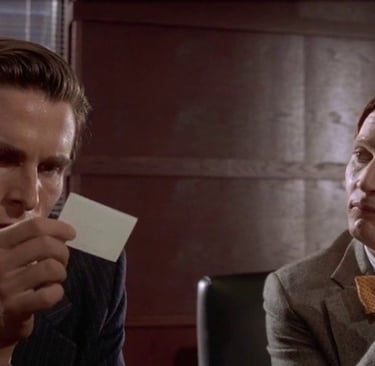
Every entrepreneur has a version of the graveyard in their office. It’s usually a desk drawer, a decorative bowl, or a rubber-banded stack sitting in the corner of a filing cabinet. Inside it lies a collection of premium cardstock, embossed logos, and glossy finishes—the relics of a thousand forgotten conversations. Business cards are such a staple, and they may even conjure up thoughts of pop culture movies like "American Psycho".
For decades, the physical business card was the undisputed currency of professional introduction. You shook a hand, exchanged a 3.5-by-2-inch piece of paper, and felt a sense of entrepreneurial accomplishment. But let’s be entirely honest: in 2026, that piece of paper isn’t a bridge to a future partnership. It is a polite piece of litter. It is a dead end in a world that moves at the speed of data.
When you hand someone a traditional business card today, you aren't initiating a relationship; you are assigning them a chore. You are asking a busy executive, a prospective client, or a potential investor to manually type your email, transcribe your phone number, or search your name across a sea of digital noise. More often than not, that card goes from their pocket to their console, and ultimately into the trash. The interaction dies because the friction is too high.
True conservative entrepreneurship is rooted in the relentless stewardship of resources—and the most valuable resource you possess is momentum. Relying on an obsolete analog tool to capture a modern professional introduction is a failure of strategy. Building on the core principles established in our recent look at The Rise of Professional Ecosystems: Digital Brand Architecture for 2026, it is time to officially declare the death of the standard business card.
To thrive in today's market, you must replace that passive paper relic with an active, high-converting digital handshake. Here is the operational blueprint for transforming a brief introduction into a permanent, revenue-producing asset.
1. The Anatomy of the High-Converting Digital Landing Page
A digital handshake is not simply a link to your company’s homepage, nor is it a genericLinktree style list of social media links. A high-converting landing page is a hyper-focused, single-purpose digital asset designed to do one thing: seamlessly transition a real-world introduction into an integrated professional ecosystem.
When someone scans your information in the field, they should land on a clean, mobile-optimized environment that acts as your definitive digital profile. This page must be clean, authoritative, and completely free of algorithmic distractions.
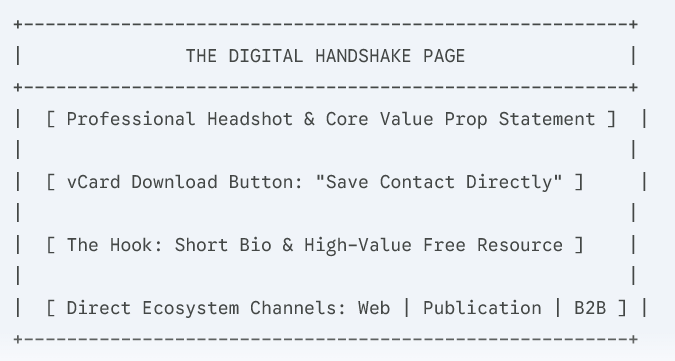
The Instant vCard Integration: At the absolute top of the page, place a prominent, foolproof action button: "Add to Contacts." When clicked, this should automatically trigger a .vcf file download that populates your full name, phone number, professional email, business address, and website directly into their phone’s native address book. Zero typing required.
The Unified Anchor: Your digital handshake page must live on your own domain (e.g., yourname.com/connect or yourfirm.com/handshake). Hosting your professional hub on third-party aggregator platforms signals a lack of brand ownership. True digital architecture requires that you own the land your business stands on.
2. Architecting the Integrated QR Ecosystem
The physical point of contact still matters, but its entire purpose has changed. Instead of carrying a box of 500 paper cards that try to tell your whole story, your physical footprint should be reduced to a single, highly efficient gateway: a custom QR ecosystem.
Whether you utilize a premium, branded NFC (Near-Field Communication) smart card that transfers data with a tap, or a meticulously designed, single-card layout that you keep in your wallet, the physical asset exists solely to deploy a QR code.
Dynamic Over Static: Never use a static QR code that links to a rigid URL. If you change your website structure or rebrand your business branches, a static code becomes useless. Use a dynamic QR code system that allows you to change the underlying destination URL at any time without altering the physical print or card.
The "Device Agnostic" Rule: Technology should never get in the way of a transaction. While NFC taps are excellent, they can occasionally fail depending on the recipient’s phone model, case thickness, or software settings. A beautifully presented dynamic QR code works universally across every smartphone camera on the market. It is reliable, immediate, and culturally frictionless.
3. Engineering a Clear, Core Narrative
A flawless digital page and a seamless QR scan are nothing more than empty mechanics if your core message is vague. In a fast-paced networking environment—whether at an East Valley business summit or a local economic development meeting—you have roughly seven seconds to articulate your value proposition before the human mind wanders.
Your digital handshake must instantly answer three fundamental questions for the recipient:
Who are you?
What specific problem do you solve?
What should I do next?
Eliminate Corporate Fluff: Replace long-winded, focus-grouped mission statements with a sharp, data-driven narrative. Instead of saying, "We provide holistic, synergistic solutions for regional commercial enterprises," say, "We audit and restructure digital brand networks to help mid-sized B2B firms capture regional corporate contracts." Be real, be grounded, and speak with absolute clarity.
The One-Sentence Hook: Your headline should mirror the exact pitch you deliver verbally. When your spoken words match the exact text that appears on their screen after they scan your code, it reinforces your authority and builds immediate cognitive trust.
4. The Fortune is in the Follow-Up: Converting the Lead
The deepest flaw of the traditional business card is its passive nature. You hand it over, walk away, and pray they remember to call you. You completely abdicate control of the business development process.
A high-converting digital handshake completely flips the power dynamic, transferring control back into the hands of the entrepreneur.
The Low-Friction Exchange: When someone scans your code and saves your contact info, your landing page should feature a simple, two-field form: Name and Email. You can look them in the eye and say, "I’d love to send over that regional economic report we just discussed—drop your email right here and it’ll hit your inbox automatically."
Automate the First 24 Hours: By integrating your landing page with a robust, localized CRM (Customer Relationship Management) tool, that interaction triggers an immediate, professional sequence. Within an hour, they receive a clean, brief email thanking them for the conversation, providing the resource you promised, and offering a direct link to schedule a brief discovery call.
The Grounded Bottom Line
The transition away from traditional business cards isn't just a tech upgrade; it’s a fundamental shift in entrepreneurial mindset. It is the recognition that professional networking is no longer about the volume of paper you distribute, but the efficiency of the digital connections you secure.
As the Phoenix metro area undergoes a historic economic transformation, local business owners cannot afford to navigate 2026 with a 1996 toolkit. Leaving your professional growth to the chance that someone might find your paper card at the bottom of a briefcase is an unnecessary business risk.
Ditch the paper graveyard. Build your dynamic landing page, secure your permanent QR infrastructure, refine your core narrative, and take absolute ownership of your professional momentum. The market belongs to the agile, the prepared, and the disciplined.
Go upgrade your handshake.
Recent Articles
Daily Phoenix © 2026
Daily Phoenix is Arizona’s premium digital magazine for faith‑forward leadership, community resilience, and local governance.
Reframe your inbox
Subscribe to our newsletter and never miss a story.
We care about your data in our privacy policy.