
Faith and the Foundation: Reflecting on the Spiritual Roots of the American Experiment
As the United States approaches its 250th anniversary, this piece explores the profound influence of Christian thought on the American Founding. From the theological roots of individual rights to the structural genius of checks and balances, discover how these spiritual foundations continue to shape our civic life and offer wisdom for navigating the challenges of today.
JUNE 2026SOUND MIND LIVING


America as a Christian nation
As the United States approaches its Semiquincentennial—the 250th anniversary of the signing of the Declaration of Independence—the nation stands at a significant crossroads. It is a moment for reflection, not merely on the geopolitical shifts of the last two and a half centuries, but on the intellectual and spiritual soil from which the American experiment first sprouted. To understand the American republic, one must contend with the profound, undeniable, and complex influence of the Christian faith upon its founders and the foundational documents that continue to shape our civic life.
The Theological Architecture of Liberty
The American Founding was not a secular event in the modern sense of the term. It was an intellectual achievement heavily scaffolded by the Christian tradition, specifically the Reformed theology that dominated the colonial mind. When Thomas Jefferson penned the immortal words of the Declaration of Independence, claiming that all men are "endowed by their Creator with certain unalienable Rights," he was not merely invoking a vague deistic principle. He was tapping into a long-established Western tradition that viewed human dignity as deriving from the Imago Dei—the belief that every human being bears the image of God.
This theological premise is the essential pillar of American liberty. If rights are granted by the state, they can be revoked by the state. By grounding these rights in a transcendent Creator, the Founders argued that they were beyond the reach of any earthly government. This idea was not invented in 1776; it was the culmination of centuries of theological debate regarding the nature of man, original sin, and the limits of human authority.
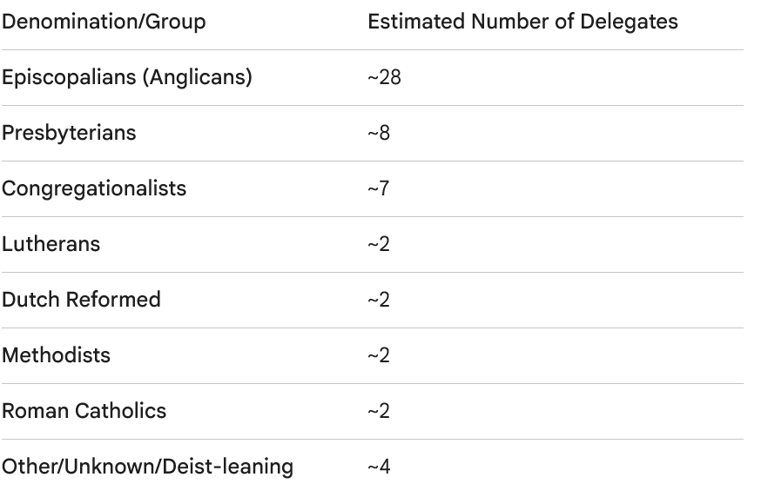
The "Overwhelmingly Christian" Perspective: Many historical analyses, often cited by researchers focusing on the cultural background of the era, point out that the vast majority of delegates were raised in Christian traditions. By these counts, upwards of 90–93% are categorized as having a Christian affiliation (predominantly Protestant denominations like Episcopalian, Presbyterian, and Congregationalist). This perspective emphasizes that even those who held Enlightenment rationalist views were culturally and intellectually shaped by Christian theology.
Breakdown of Denominational Affiliations
While specific percentages of "sincere belief" are impossible to verify, historical records of the delegates' primary religious backgrounds are generally identified as follows:


Sin, Structure, and the Checks on Power
Perhaps the most practical impact of Christian thought on the American Constitution is the doctrine of human depravity. While Enlightenment thinkers debated the perfectibility of man, the Founders—influenced deeply by the sobering realism of the Christian tradition—were skeptical of human nature.
James Madison, in Federalist No. 51, famously captured this sentiment: "If men were angels, no government would be necessary. If angels were to govern men, neither external nor internal controls on government would be necessary."
This was not a cynical view, but a biblical one. The system of "checks and balances" that defines our republic is essentially a structural solution to the theological problem of sin. Because power tends to corrupt, and because no individual is virtuous enough to be trusted with absolute authority, the Founders designed a system that assumed human fallibility. By pitting "ambition against ambition," they created a framework that sought to contain the inherent selfishness of the human heart, protecting the citizenry from the tyranny of the few or the many.
The Protestant Ethic and the Public Square
The intellectual infrastructure for the American Revolution was also built in the pulpits of the colonial era. Historians have frequently pointed to the "Black Robe Regiment"—pastors who, during the lead-up to the war, articulated a robust defense of resistance to tyranny grounded in their biblical interpretation of justice and governance.
These leaders did not view the separation of church and state as a requirement for the secularization of the public square. Rather, they saw the church as the conscience of the nation. The idea of the "covenant"—a biblical concept—was foundational to the American political consciousness. It shaped the notion that the people were in a contract not only with their leaders but with one another under the authority of a higher moral law.
This moral framework fostered a culture of individual responsibility, education, and social charity. The proliferation of colleges, hospitals, and benevolent societies throughout the 18th and 19th centuries was largely the fruit of a Christian worldview that emphasized service to one's neighbor as an extension of one's love for God.
A Pluralistic Society with a Specific Heritage
Acknowledging these Christian foundations does not negate the existence of a diverse and pluralistic America. The Founders were deeply committed to the idea of religious freedom—a concept itself rooted in the Christian belief in the sanctity of conscience. They recognized that faith cannot be coerced, and that a truly vibrant religious life requires the voluntary choice of the individual.
However, recognizing the Christian heritage of the United States is about historical accuracy. It is acknowledging that the language of our founding documents—the focus on duty, stewardship, equality, and the inherent worth of the individual—was translated into the vernacular of the 18th century from a much older, deeper reservoir of Christian thought.
To look at the Declaration of Independence or the Constitution without acknowledging the theological assumptions of their authors is to read a map without understanding the coordinates. The American experiment was built on the premise that a free society can only sustain itself if it is populated by a people who understand themselves to be accountable to something greater than the state.
Toward a 250th Anniversary of Renewed Understanding
As we march toward 2026, the rhetoric surrounding the nation’s birthday is often polarized. We are prone to either idolizing the past, ignoring its flaws, or deconstructing it until nothing remains of its core principles. A more mature, and perhaps more "sound-minded," approach is to view this anniversary as an invitation to a deeper conversation about what actually makes a republic hold together.
It is the historical story of the American people. It is the story of a nation that has consistently sought to refine its adherence to its own foundational principles. Every major movement for civil rights, social justice, and political reform in American history has relied heavily on the vocabulary of the American founding—a vocabulary that, at its heart, speaks to the inherent dignity of the human person.
In honor of the upcoming 250th birthday, let us commit to a more rigorous, honest exploration of these roots. This is not about enforcing a singular religious worldview upon a pluralistic society, but about recognizing that our current democratic health is deeply dependent on the wisdom of the past.
As we reflect on what constitutes the American experience, we might find that the most resilient parts of our national identity are those that emphasize humility, the limitation of power, and a commitment to the common good—values that were nurtured in the very Christian foundations that the founders held dear. In doing so, we might not only honor our history but also find the tools necessary to navigate the challenges of the future with confidence and clarity.
As we look forward to the nation's 250th birthday, how do you see these historical foundations influencing the challenges we face in our communities today?
Recent Articles
Daily Phoenix © 2026
Daily Phoenix is an online magazine that keeps you up to date on what matters.
Reframe your inbox
Subscribe to our newsletter and never miss a story.
We care about your data in our privacy policy.