
Maximizing Energy Efficiency in Older Arizona Homes: Retrofitting for the Desert Climate
Master the brutal Arizona summer by retrofitting your older home for maximum energy efficiency. Discover practical, high-impact strategies—from attic insulation and Low-E window glazing to duct sealing and cool roof coatings—designed to slash utility bills and beat the desert heat.
JULY 2026THE BLUEPRINT
Energy Efficiency in Arizona
If you have ever walked across an uncarpeted bedroom floor in a 1970s ranch home in central Phoenix or an older suburban build in Mesa during late July, you already know the distinct signature of desert heat. It does not just sit outside; it creeps through drywall, radiates downward from poorly insulated roof decks, and presses relentlessly against single-pane glass until your air conditioning unit sounds like a jet engine trying to lift off the tarmac.
For owners of vintage Arizona properties, the charm of mature neighborhoods—deep-set lots, established ficus trees, and custom architectural layouts—comes with a steep seasonal tax. When summer temperatures routinely clear the 110-degree mark, an inefficient building envelope turns monthly utility statements into a minor financial crisis.
Energy efficiency here is not an abstract philosophical exercise or a mild lifestyle preference; it is a defensive strategy. Retrofitting an older desert home requires looking past cookie-cutter national energy advice and dealing head-on with the brutal thermal physics of the Sonoran Desert.
The Desert Thermal Equation: Understanding How Heat Moves
To fix an inefficient home, you have to understand how heat enters it. In colder climates, heating engineers worry about convective heat loss—warm air escaping through cracks and gaps. In the Arizona desert, the primary enemy is radiant heat gain.
During a typical summer afternoon, solar radiation beats down on asphalt shingles, concrete tile roofs, and exterior walls. That thermal energy does not just disappear when the sun goes down. It stores in the building materials and conducts inward for hours, keeping attic temperatures hovering around 140 to 160 degrees long after dark.
Older homes—particularly those built during the post-war housing booms through the 1980s—were often constructed with minimal regard for thermal performance. Builders back then relied on cheap electricity and massive, inefficient HVAC systems to brute-force indoor comfort. Today, with energy rates climbing and summers growing more punishing, that brute-force approach is unsustainable.
Tackling this problem systematically means working from the top down and the outside in, starting with the area where your home takes the heaviest beating: the roof and attic.
1. Conquering the Attic: Insulation and Radiant Barriers
If your home is uncomfortable, your first stop should always be the attic. In an unshaded desert home, the roof acts as a giant solar collector, and the ceiling acts as a radiator cooking the living space below.
Upgrading Loose-Fill or Batt Insulation
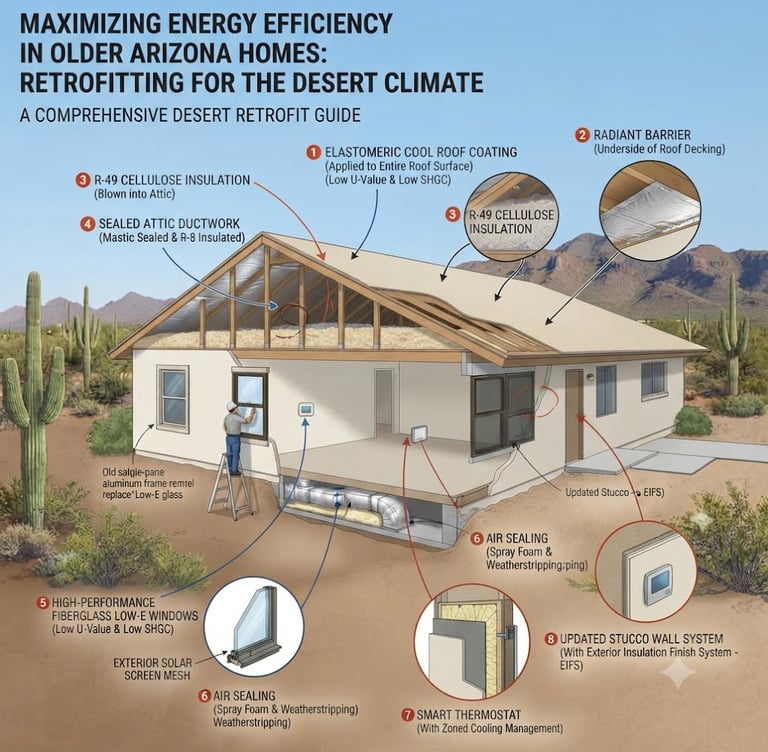
Most homes built before the late 1990s feature paltry attic insulation levels—often R-19 or lower (roughly six inches of faded fiberglass batts or thinning cellulose). Modern building standards for Climate Zone 2 recommend pushing attic insulation to R-38 to R-49, which translates to roughly 14 to 18 inches of material.
When upgrading, you have two primary choices for loose-fill insulation:
Fiberglass: Resistant to settling and non-combustible, though it loses some thermal effectiveness if it gets damp or compressed.
Cellulose: Made largely from recycled paper treated with borate (which also acts as a natural fire retardant and pest deterrent). Cellulose packs tightly into crevices, creating a denser thermal blanket that blocks airflow better than fiberglass.
Pro Tip: Before blowing in new insulation, seal all ceiling penetrations—light fixture boxes, wire chases, plumbing vents, and drywall cracks—using high-temperature expanding foam. If warm air from your living space leaks up into the attic, it carries moisture and creates thermal loops that degrade your insulation's performance.
The Role of Radiant Barriers
While mass insulation slows down conductive heat transfer, a radiant barrier stops radiant heat. Installed on the underside of your roof rafters, a clean aluminum foil sheet reflects up to 97% of the radiant heat bouncing off your hot roof deck before it ever reaches your attic floor insulation.
While radiant barriers won't eliminate the need for thick attic insulation, they can reduce attic air temperatures by 10 to 30 degrees during peak afternoon hours. This drop prevents your ceiling drywall from turning into a radiant heater and keeps your AC ductwork—which is frequently routed through unconditioned attic spaces—from super-cooling or pre-heating air before it reaches your vents.
2. Replacing the Weakest Link: Windows and Glazing
Walk through any home built in the Valley thirty or forty years ago, and you will likely find aluminum-framed windows fitted with single-pane glass. Structurally, these windows are thermal disasters. Aluminum is an exceptional conductor of heat; it acts as a literal highway for outdoor heat to transfer straight into your living room. Furthermore, single-pane glass offers almost zero resistance to solar radiation.
Upgrading to Modern Vinyl or Fiberglass Frames
When retrofitting for the desert, frame material matters as much as the glass.
Avoid standard aluminum unless it features an integrated thermal break (a physical barrier inside the frame that stops heat conduction).
Vinyl frames are cost-effective, excellent at insulating, and won't warp or fade when properly UV-stabilized.
Fiberglass frames offer superior dimensional stability, expanding and contracting at the same rate as glass, making them exceptionally durable against the extreme temperature swings of the desert.
Understanding Low-E Glass Packages
Not all double-pane windows are created equal. If you buy standard double-pane glass designed for a northern climate, you might actually trap heat inside your home during mild winter days or summer nights.
For Arizona, you need Low-E (Low-Emissivity) coatings engineered specifically for solar heat gain control:
Look for a low Solar Heat Gain Coefficient (SHGC)—ideally below 0.25. The lower the number, the more infrared solar radiation the glass blocks.
Ensure the space between the glass panes is filled with argon gas, which is denser than air and slows down conductive heat transfer.
Exterior Shading Strategies
Even the best window performance can't compete with direct, uninhibited desert sun striking glass for six hours straight. If replacing every window in the house isn't in the budget, prioritize retrofitting the west- and south-facing windows first, and supplement them with exterior sun screens. Exterior mesh solar screens can block up to 80% to 90% of solar heat before it ever touches the glass, preserving your indoor comfort while maintaining outward visibility.
3. Sealing the Envelope: Air Sealing and Duct Integrity
In an older home, invisible gaps around doors, windows, utility penetrations, and recessed lighting can combine to equal an open window left running all day. Air infiltration doesn't just let hot air in; it forces your overworked air conditioner to constantly process unconditioned, humid outdoor air (or dry, dusty monsoon air).
Comprehensive Weatherstripping
Check the weatherstripping around every exterior door. If you can see daylight beneath your front door, or if the rubber seal is flattened and brittle, replace it immediately with heavy-duty silicone or interlocking metal sweeps. For older windows, sash locks should pull the window tightly against the frame to compress the weatherstripping; loose latches mean air leaks.
Duct Testing and Sealing
Many homeowners invest thousands in a high-efficiency HVAC unit, only to pump that cooled air straight into a leaky attic or crawlspace through aging, disconnected ductwork.
Duct Mastic: Have a certified technician pressure-test your duct system. Seal all joints, plenums, and take-offs using fiber-reinforced mastic rather than duct tape (which dries out and crumbles rapidly in hot attic environments).
Duct Insulation: Ensure your flexible or metal ducts are wrapped in R-8 insulation jackets. If your ducts are resting directly on the hot attic floor, elevating them or adding insulation underneath prevents conductive heat gain from warming the air inside the tubes.
4. Cool Roof Technologies and Exterior Coatings
When your home's roof reaches the end of its functional life—whether it's composition shingle, concrete tile, or flat foam—your choice of replacement material dictates your summer baseline temperature.
INSULATION + AIR SEALING
A comprehensive, practical walkthrough on properly insulating and air sealing older home attics. The video covers critical thermal boundaries, preventing condensation and mold issues, and protecting roof structures and sheathing when upgrading energy efficiency..

Cool Tile and Shingle Options
Traditional dark gray or black roofing materials absorb up to 90% of sunlight, driving surface temperatures past 150 degrees. Modern "cool roof" technologies feature specially pigmented granules or tiles that reflect a much higher percentage of solar energy. Light-colored concrete tiles or light-toned elastomeric coatings on flat roofs can lower surface temperatures by 50 degrees compared to dark surfaces, dramatically reducing the heat load transferred into your attic.
Elastomeric Coatings for Flat Roofs
Many mid-century Arizona homes feature low-slope or flat roofs. If yours is covered in polyurethane foam or built-up roofing, applying a thick, highly reflective elastomeric acrylic coating every few years acts as an effective solar shield. It reflects sunlight, seals micro-cracks, and prevents the thermal expansion that leads to monsoon leaks.
5. Smart Thermostats and Zoned Cooling Management
Retrofitting isn't just about physical materials; it’s also about how you manage your cooling load. Older homes often suffer from uneven temperature distribution—the master bedroom is freezing, but the kitchen and den are stifling.
Installing a smart learning thermostat (such as a Nest or Ecobee) paired with remote room sensors allows you to balance temperatures across different zones of the house. Furthermore, smart thermostats integrate with local utility demand-response programs, allowing you to precool your home during off-peak hours and coast through peak pricing windows without sacrificing comfort.
"Energy efficiency here is not a abstract philosophical exercise or a mild lifestyle preference; it is a defensive strategy."
The Long-Term Return on Investment
Energy retrofitting in the desert is rarely cheap upfront, but unlike cosmetic renovations, it pays direct, recurring dividends. Lowering your peak summer electricity demand can slash hundreds of dollars off your monthly utility bills during July, August, and September.
More importantly, it transforms an aging, uncomfortable property into a resilient desert sanctuary. By taking a systematic approach—securing the attic, upgrading glazing, sealing air leaks, and managing solar radiation—you ensure that your older Arizona home remains comfortable, efficient, and valuable for decades to come.
Recent Articles
Daily Phoenix © 2026
Daily Phoenix is Arizona’s premium digital magazine for faith‑forward leadership, community resilience, and local governance.
Reframe your inbox
Subscribe to our newsletter and never miss a story.
We care about your data in our privacy policy.