
Part 1: Understanding the Differences Between ESA and STO in Arizona
Arizona parents hear these acronyms everywhere — ESA, STO, school choice, tax credits — but few truly understand how these programs differ or what they actually mean for their family. This explainer breaks down the two major education‑funding pathways in Arizona: Education Savings Accounts (ESAs) and School Tuition Organizations (STOs). In clear, practical language, it outlines how each program works, who qualifies, how funds are distributed, and what families can (and cannot) use them for. Whether you’re a parent navigating options, a taxpayer trying to understand where your dollars go, or a community leader shaping the conversation, this guide gives you the clarity you need to make informed decisions in Arizona’s evolving education landscape.
MAY 2026THE CITIZEN & THE ACTIVISTEDUCATION


Part 1: STO vs ESA Breakdown
Arizona has long been the pioneering vanguard of the school choice movement. For decades, our state has been championing the fundamental conservative principle that parents—not government bureaucrats or zip codes—should control their children’s education. By introducing free-market competition into a stagnant public school monopoly, Arizona has created a dynamic educational marketplace that respects parental rights, protects religious liberty, and ensures that taxpayer dollars follow the student rather than funding failing institutional brick and mortar.
However, as the educational landscape expands, navigating the mechanics of school choice can become confusing. Arizona families and freedom-loving taxpayers frequently encounter two primary pillars of our school choice infrastructure: Empowerment Scholarship Accounts (ESAs) and School Tuition Organizations (STOs).
While both programs break the monopoly of traditional public districts and lower financial barriers to private education, they function in fundamentally different ways. Understanding the operational, financial, and philosophical differences between ESAs and STOs is essential for any Arizona family seeking the best fit for their children, and for any taxpayer looking to maximize their impact on our community’s future.
The Core Definitions: Understanding the Mechanisms
To understand how these programs differ, we must first look at where the money comes from and how it is allocated.
1. Empowerment Scholarship Accounts (ESAs)
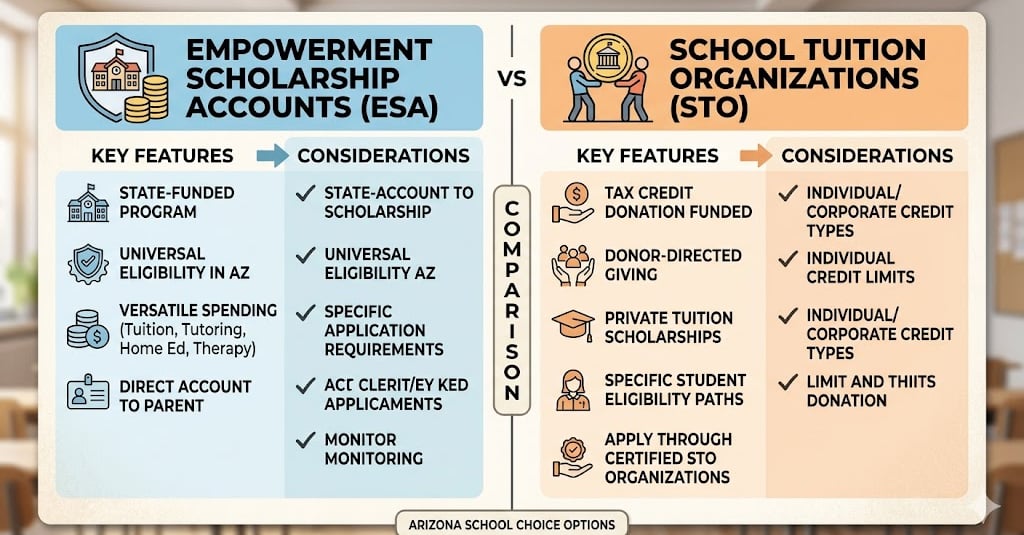
The ESA program is a direct, state-funded parental empowerment model administered by the Arizona Department of Education. Instead of the state sending your child’s allocated public education dollars directly to a district public school, the Arizona Department of Education deposits those funds directly into an account controlled by the parent, managed via online platforms like ClassWallet.
In Arizona, the ESA is universal. This means any K–12 student residing in Arizona who is eligible to attend a public school can instead opt out and receive an ESA. For a standard student, this translates to roughly $7,000 to $8,000 per year (and significantly more for students with diagnosed special needs or disabilities).
“STOs keep education rooted in community — neighbors investing in neighbors, not institutions.”
2. School Tuition Organizations (STOs)
The STO program, by contrast, is a privately funded, tax-credit-driven scholarship model. It does not use direct state education allocations. Instead, it relies on the voluntary generosity of Arizona individual taxpayers and corporations who redirect their state income tax liabilities to certified, private non-profit School Tuition Organizations.
Instead of writing a check to the Arizona Department of Revenue, a taxpayer writes a check to an STO. The STO then bundles these private donations and distributes them as tuition scholarships to qualified K–12 students attending private schools. For the taxpayer, it is a dollar-for-dollar tax credit, effectively giving citizens direct control over how their tax dollars are spent.
Side-by-Side Comparison: ESA vs. STO.
The Philosophical Divide: Direct Empowerment vs. Community Charity
From a conservative perspective, both models represent major victories over government-dominated education, but they express different conservative values.
The ESA: Ultimate Decentralization
The ESA represents the ultimate decentralization of government power. It treats education as a service customized to the individual child. It acknowledges that a child's learning is not a one-size-fits-all conveyor belt. By putting public funds directly into a parent’s hands, the ESA cuts out the middlemen—superintendents, school boards, and union bosses—and trusts families to build a customized educational portfolio. If a child needs private school for math, a private tutor for reading, and specialized curriculum for science, the ESA can fund all three simultaneously.
The STO: Localism, Charity, and Civil Society
The STO model taps into a different, equally vital conservative pillar: civil society, voluntary association, and religious liberty. STOs allow individual citizens to directly support the moral, cultural, and religious institutions within their own communities.
When a taxpayer utilizes the Private School Tuition Tax Credit, they are bypassing government structures entirely to invest in local private and parochial schools. For Tax Year 2026, a married couple filing jointly can redirect up to $3,131 (combining the Original and Switcher/PLUS credits) directly to an STO. This keeps resources local, strengthens private communities, and allows donors to advocate for schools that teach traditional values, patriotism, and faith without fear of state entanglement.
The Golden Rule: You Cannot Double Dip
For parents trying to maximize their options, there is a strict, non-negotiable rule set by Arizona law: A student cannot simultaneously use ESA funds and receive STO scholarships.
Important Notice for Parents: Because the ESA program utilizes public state funds and the STO program utilizes tax-credit-funded private scholarships to cover private education, stacking them for the same student during the same period is illegal.
If your child is actively enrolled in the ESA program, any STO scholarships they hold must be put on hold, and they cannot accept new STO funds. If you decide to transition from an STO to an ESA, you must officially notify your private school and the respective tuition organizations to ensure compliance.
How to Choose Between ESA and STO for Your Child
If you are deciding which path is best for your family, consider these operational realities:
Choose the ESA if: You desire complete educational flexibility beyond just private school tuition. If you are homeschooling, utilizing hybrid models, hiring private tutors, or if your child has special needs requiring custom therapies and assistive technologies, the ESA is unmatched in its flexibility.
Choose the STO if: Your child is enrolled full-time in a traditional private school, and the cost of tuition exceeds the standard $7,000–$8,000 ESA allocation. Because STOs allow you to receive scholarships from multiple individual and corporate pools, families with students in higher-tuition private high schools often find that combining multiple STO grants covers more of the tuition bill than a baseline ESA.
For the Taxpayer: The Power of the STO Tax Credit
While parents focus on the educational outcomes, Arizona citizens and small business owners should look closely at the STO as a powerful tool for financial stewardship.
Arizona allows for incredible credit stacking. According to 2026 tax guidelines, a married couple can claim up to $1,570 for the Original private school credit and $1,561 for the Switcher/PLUS credit, assuming they meet the minimum donation requirements. This can be stacked right alongside other state tax credits, such as the Qualifying Charitable Organization (QCO) credit and the Public School tax credit, to drastically lower or entirely eliminate state tax liabilities.
Furthermore, Arizona C corporations, S corporations, and LLCs that face corporate state income tax liabilities can participate in corporate STO programs. This allows corporate leaders to keep their hard-earned business capital in Arizona, directly funding low-income scholarships or scholarships for displaced and disabled students, rather than surrendering those funds to the general state fund.
Defending the Future of School Choice
Left-wing activists and teachers' unions continuously target Arizona's school choice victories, labeling ESAs and STOs as "drains" on public infrastructure. But conservatives know the truth: competition breeds excellence. By providing healthy alternatives, public school districts are incentivized to perform better, communicate more transparently with parents, and focus on core academics rather than political indoctrination.
Whether you are a parent taking charge of your child's future through an Empowerment Scholarship Account or a taxpayer reclaiming your hard-earned dollars through a School Tuition Organization, you are participating in the freest, most robust educational marketplace in America. By understanding the mechanics of these two programs, we can better defend them, utilize them efficiently, and ensure that Arizona remains a beacon of freedom and parental rights for generations.
Share your thought. Are you utilizing Arizona STO or ESA programs?
This is part 1 of a 3 part series on Arizona's ESA program. For more information on the why behind ESA check out parts one, two & three
Recent Articles
Daily Phoenix © 2026
Daily Phoenix is Arizona’s premium digital magazine for faith‑forward leadership, community resilience, and local governance.
Reframe your inbox
Subscribe to our newsletter and never miss a story.
We care about your data in our privacy policy.