
Understanding the Proposed Light Rail and Bus Rapid Transit Expansions in East Valley Transit
As the East Valley weighs major investments in light rail and Bus Rapid Transit, this explainer breaks down what residents need to know about the proposed routes, costs, and long‑term mobility impacts. It outlines why regional planners are pushing for expanded high‑capacity transit and how these projects could reshape commuting patterns, economic development, and neighborhood connectivity.
MAY 2026THE CITIZEN & THE ACTIVIST

The Horizon of East Valley Transit: De-mystifying the Proposed Light Rail and Bus Rapid Transit Expansions
For decades, the cultural blueprint of the East Valley has been defined by a distinct brand of suburban freedom: master-planned family neighborhoods, wide-open desert horizons, and the quiet luxury of the personal vehicle. But as over $100 billion in semiconductor investments and enterprise tech corridors flood into Phoenix, Chandler, Mesa, and Gilbert, our infrastructure is facing a monumental reckoning. Let's walk through what is happening in our community.
The question is no longer whether the East Valley will grow—it is a question of how that growth will move.
At the center of this debate is a series of regional transit planning proposals aimed at pushing high-capacity public transportation deeper into our backyard. For local residents, business owners, and taxpayers, these projects are frequently shrouded in complex bureaucratic jargon. Headlines alternate between utopian promises of economic connectivity and apocalyptic warnings of tax waste and rising crime.
To lead with conviction and live with intention, East Valley citizens must look beyond the noise. This practical explainer breaks down the realities of the proposed light rail adjustments and Bus Rapid Transit (BRT) expansions, weighing the real pros and cons for our traffic patterns, neighborhood property values, and hard-earned tax dollars.
The Blueprint: What is Actually Being Proposed?
To understand the future, we have to look at the current infrastructure line. The most prominent fixed-rail transit asset in our immediate vicinity is the 1.9-mile Gilbert Road Light Rail Extension, which pushed the existing Valley Metro light rail line along Main Street from Mesa Drive to Gilbert Road.
While that rail extension terminated right at the western edge of Gilbert’s boundary, regional planners are consistently looking south and east. Because building physical rail tracks costs upwards of $100 million per mile, regional focus has increasingly shifted toward a more flexible alternative: Bus Rapid Transit (BRT).
Unlike a standard municipal bus that stops at every street corner and crawls through commuter traffic, BRT is designed to mimic a train on rubber tires. It utilizes dedicated transit lanes, specialized stations with pre-board ticketing, and traffic-signal priority technology to move large volumes of commuters down major arterial corridors (such as Southern Avenue, Broadway Road, or Arizona Avenue) at high speeds.
For the East Valley, BRT represents the likely compromise between the absolute permanence of rail and the operational flexibility required by our sprawling geography.
The Pros: The Case for High-Capacity Transit
While public transit is traditionally viewed through a progressive lens, a compelling, fiscally conservative argument exists for well-executed, high-capacity corridors when they protect the taxpayer and foster organic economic growth.
1. Slashing Long-Term Infrastructure Infrastructure Costs
As a household grows, so does its overhead. The same applies to a municipality. Widening a major arterial road or a highway like the US-60 or Loop 202 (The Kirkway) is an extraordinarily expensive endeavor that yields diminishing returns; more lanes simply attract more cars. High-capacity transit lines—particularly BRT corridors—can move thousands of commuters daily without tearing up extra lanes of concrete or requiring massive, ongoing asphalt maintenance funded by local property taxes.
2. Catalyzing Market-Driven Economic Development
Capital follows infrastructure. We have already seen this play out in downtown Mesa. According to official data from Valley Metro, the extension of the light rail line to Gilbert Road directly catalyzed over $240 million in completed economic development projects, with more private investment currently in the pipeline. By creating fixed, predictable transit hubs, cities give commercial developers the confidence to build mixed-use retail, dining, and professional office spaces, shifting the tax burden away from residential homeowners and onto commercial sales tax revenues.
3. Future-Proofing the Local Workforce
The East Valley is no longer just a bedroom community for downtown Phoenix; it is an industrial and tech powerhouse. For the thousands of families moving to the region to work in manufacturing, logistics, and technology, reliable connectivity is vital. Providing high-capacity lines ensures that our service workers, entry-level corporate professionals, and tech interns can access major employment centers efficiently, keeping our local economy nimble and competitive.
The Cons: The Risks to Suburban Sovereignty and Fiscal Discipline
Every investment carries a risk, and the expansion of urban-style transit into deeply suburban communities demands rigorous scrutiny. The concerns raised by local families and neighborhood activists are grounded in real, historical data.
1. The Threat of "Density Creep" and Property Value Volatility
The greatest draw of the Gilbert and Southeast Mesa corridors is their family-first architecture: safe, quiet streets, master-planned developments, and biophilic open spaces. High-capacity transit inherently demands high-density zoning nearby to justify its operational costs. For residents living near proposed transit lines, this can mean a forced shift from quiet suburban neighborhoods to mid-rise apartments. While commercial property values near transit lines frequently skyrocket, single-family residential properties directly adjacent to light rail or BRT lines can experience volatility due to increased noise, localized traffic bottlenecks, and shifting neighborhood dynamics.
2. Fiscal Liability and Ridership Deficits
Public transit systems are rarely self-sustaining. They rely heavily on subsidies funded by regional sales taxes (such as Prop 400 extensions) and federal grants. If an expensive BRT or light rail corridor is built and fails to meet projected ridership numbers, the ongoing operational deficit falls directly back on the local municipality. In a time of economic uncertainty, committing long-term public funds to underutilized transit lines threatens the fiscal health of our cities and pulls resources away from essential services like local law enforcement, road repair, and park maintenance.
3. The "Pipeline Effect" for Urban Spillover
A primary concern among East Valley homeowners is that extending fixed transit corridors creates a direct pipeline for the urban challenges plaguing larger metropolitan centers—namely, localized homelessness, property crime, and loitering. Unlike personal vehicles, open-access transit networks require extensive, active policing to maintain safety. Without a dedicated, significant increase in local police budgets to patrol transit stations, neighborhoods near these hubs can experience an erosion of the safety and order that make the East Valley so desirable for raising families.
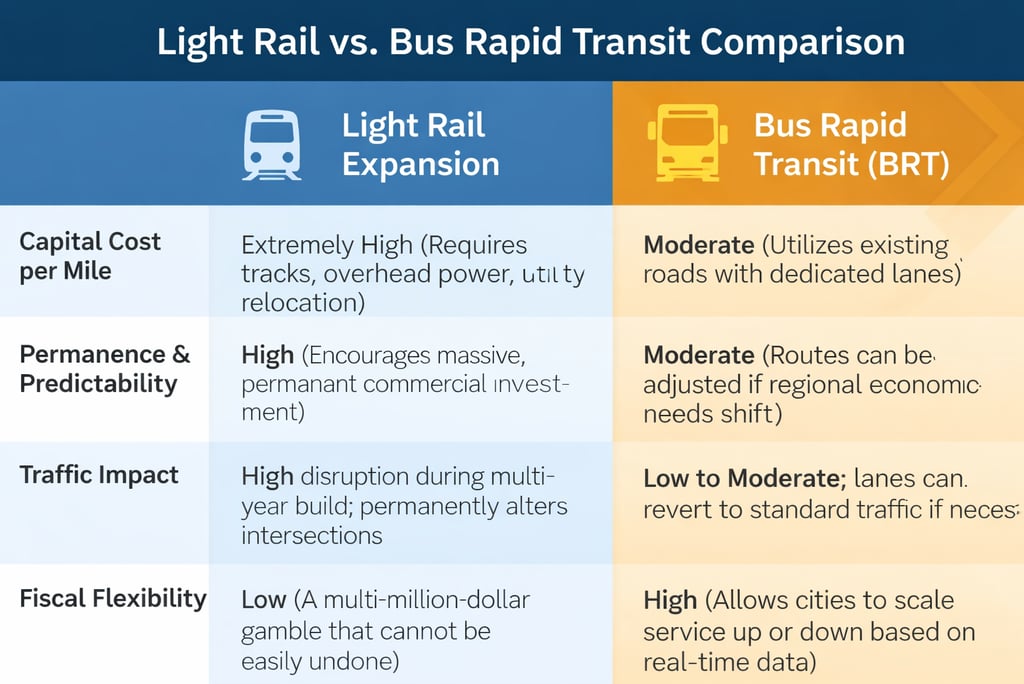
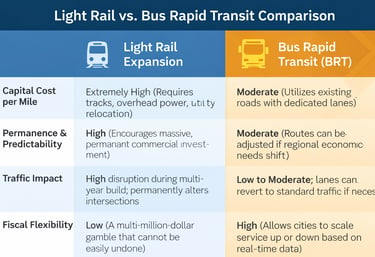
From a balanced growth-minded perspective, Bus Rapid Transit emerges as the safer, more accountable option for the East Valley's next chapter. It respects the hard-earned dollars of the taxpayer by avoiding the astronomical sunken costs of steel rail, while still providing the infrastructure framework necessary to support our booming business corridors.
Show Up, Speak Up: How to Make Your Voice Heard
A family legacy and a strong community do not happen by accident; they are built with intentionality, active citizenship, and a refusal to let bureaucratic boards make decisions in the dark. Public influence doesn't end at the ballot box—it begins in the public forums where these regional plans are actively shaped.
Valley Metro and local city councils are currently seeking community feedback regarding upcoming regional service modifications and long-term transit frameworks. If you want to protect your property values, question the allocation of your tax dollars, or support smart infrastructure growth, you need to step into the room.
Upcoming Public Action Items:
The Event: October 2026 Proposed Service Change Hybrid Public Hearing
The Date & Time: Wednesday, May 27, 2026, from 5:00 p.m. to 6:00 p.m.
How to Participate: This is a hybrid forum, meaning you can show up to voice your perspective either in person or virtually. If you cannot attend the live session, you can review the specific route proposals and submit your formal, binding public comments via the official online survey at valleymetro.org/servicechanges.
The Deadline: All formal citizen feedback and public comments must be submitted by June 13, 2026, to be entered into the official record for the final implementation plan.
Our cities are growing at a breathtaking pace. We can either sit back and watch planners turn our suburban corridors into concrete transit grids, or we can show up, speak with conviction, and ensure that the future of East Valley transit respects the families, the taxpayers, and the unique heritage that makes this desert our home. Speak up for Arizona.
Make your voice heard. What are your thoughts about the Light rail?
Recent Articles
Daily Phoenix © 2026
Daily Phoenix is Arizona’s premium digital magazine for faith‑forward leadership, community resilience, and local governance.
Reframe your inbox
Subscribe to our newsletter and never miss a story.
We care about your data in our privacy policy.