
Mastering SEO for Local Creators: Auditing Your Small Business's Online Presence
Ready to dominate your local market? Discover the essential steps to auditing your Google Business Profile, performing competitor gaps, and leveraging hyper-local content to ensure your small business stays at the top of local search results—all on a shoestring budget.
JULY 2026BUSINESS AND CAREER BUILDER


SEO for Local Creators: How to Audit and Optimize Your Site on a Shoestring Budget
In the digital age, being a local creator—whether you run a boutique agency, a specialized service business, or a community-focused brand—is no longer just about word-of-mouth. It’s about being "findable." When your neighbors pull out their phones and type "best [service] near me," you want your name at the top of the list.
The good news? You don’t need a massive marketing budget or a team of consultants to compete with national corporations. In fact, your greatest advantage is your "hyper-local" authenticity. Here is how you can audit and optimize your website to dominate regional searches without breaking the bank.
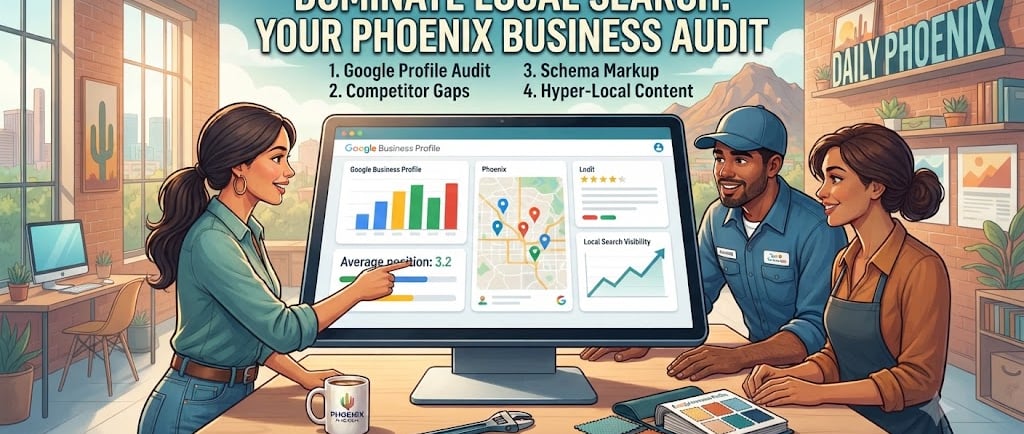
1. The Foundation: Audit Your Google Business Profile
Before you touch a single line of code on your website, look at your Google Business Profile (GBP). For local creators, this is your most important digital storefront. It’s the primary driver of the "Map Pack"—the three local listings that appear at the top of Google Maps.
Audit Checklist:
Consistency (NAP): Does your Name, Address, and Phone number (NAP) exactly match what’s on your website and social media? Even a minor discrepancy like "St." versus "Street" can confuse search algorithms.
Categories: Are you using the most specific primary and secondary categories available? Avoid generic labels; choose ones that precisely describe your business.
Photos: Businesses with high-quality, authentic photos get more clicks. Upload shots of your team, your workspace, or your finished products.
Q&A: Don’t wait for customers to ask questions. Pre-emptively fill out the Q&A section with FAQs about your services, hours, and parking.
2. Perform a "Competitor Gap" Audit
You don’t have to guess what works. Look at the businesses currently ranking in the top three spots in your local area.
Search for your primary keywords (e.g., "web designer in Gilbert") and observe the results.
Analyze the leaders: What are they doing that you aren't? Do they have more reviews? Is their website faster? Do they have dedicated pages for each of the neighborhoods they serve?
Identify the gap: Often, the difference isn't a secret "black hat" SEO trick; it’s simply a matter of completeness. If they have 50 reviews and you have five, your goal is to build a systematic process to ask every happy client for a review immediately after service completion.
3. Website Signals: The "Local" Polish
Your website is where Google sends people to confirm that you are a legitimate, trustworthy entity. To rank better regionally, your site needs to scream "local."
Use Localized Landing Pages
If you serve multiple cities or neighborhoods, don’t just shove them all onto your "Contact" page. Create dedicated, helpful landing pages for each area. A page titled "Graphic Design Services in Gilbert" is far more likely to rank for a Gilbert-based search than a generic "Our Services" page.
The Power of Schema Markup
If this sounds technical, don't panic. Schema markup is simply a snippet of code that acts as a "universal translator" for search engines. It tells Google: "This is a business, located here, open at these hours, and it sells these products." Plugins like Yoast SEO or RankMath (for WordPress) can generate this for you automatically. It removes all guesswork for the algorithm, making it much more likely that your information appears correctly in search snippets.
Optimize for "Conversational" Search
Modern search is shifting toward voice assistants and AI-driven answers. Instead of just targeting robotic phrases like "plumber Phoenix," optimize for the questions people actually ask.
Create an FAQ section: Use headers like "How do I find an affordable graphic designer in the East Valley?" or "What are the common office design trends in Phoenix for 2026?" These natural-language headers are catnip for Google’s AI.
4. Content That Connects: The "Local Creator" Advantage
National brands write generic, "SEO-optimized" blogs that lack soul. As a local creator, you can out-rank them by being too specific for them to compete.
Be the Community Hub: Write about local charity events you sponsor, neighborhood-specific buying guides, or case studies featuring real local clients.
Internal Linking: Once you write a great local article, link to it from your service pages. This passes "authority" from your high-value content to your money-making pages.
Update, Don't Just Create: Old content is a hidden goldmine. Go back to your existing blog posts, update them with 2026 information, add new images, and change the "published date." Google loves fresh content, and a "refresh" often boosts an old post back to the top of the rankings.
5. Technical Health on a Budget
You don't need a custom-built site to rank. You just need a functional one.
Mobile Speed is Non-Negotiable: Most local searches happen on a phone while the user is on the go. Use Google PageSpeed Insights to check your site speed. If it’s slow, it’s usually because your images are too large. Compress your images before uploading them.
The "Click-to-Call" Rule: Ensure your phone number is a "click-to-call" link in your header or mobile menu. If a user has to copy-paste your number into their dialer, you’ve already lost them to a competitor.
"SEO is not a sprint; it’s a marathon of incremental improvements."
The Bottom Line: Consistency Wins
SEO is not a sprint; it’s a marathon of incremental improvements. You don't need to do everything on this list in a single weekend. Spend one hour a week focused on one task—perhaps updating one service page, asking three clients for reviews, or writing one hyper-local blog post.
By focusing on being the most helpful, visible, and authentic business in your specific region, you signal to Google that you are the "go-to" authority. That is how you win in local search—one happy neighbor at a time.
Recent Articles
Daily Phoenix © 2026
Daily Phoenix is Arizona’s premium digital magazine for faith‑forward leadership, community resilience, and local governance.
Reframe your inbox
Subscribe to our newsletter and never miss a story.
We care about your data in our privacy policy.