
The Art of the Evening Walk: Reclaiming Neighborhood Connections
Step out of the air-conditioned bunker and reclaim the Valley's twilight. Discover why the evening walk is a radical act of community connection in Phoenix, featuring the best urban canal routes, historic shaded neighborhoods, and practical tips for beating the summer heat after dark.
JULY 2026SOUND MIND LIVING
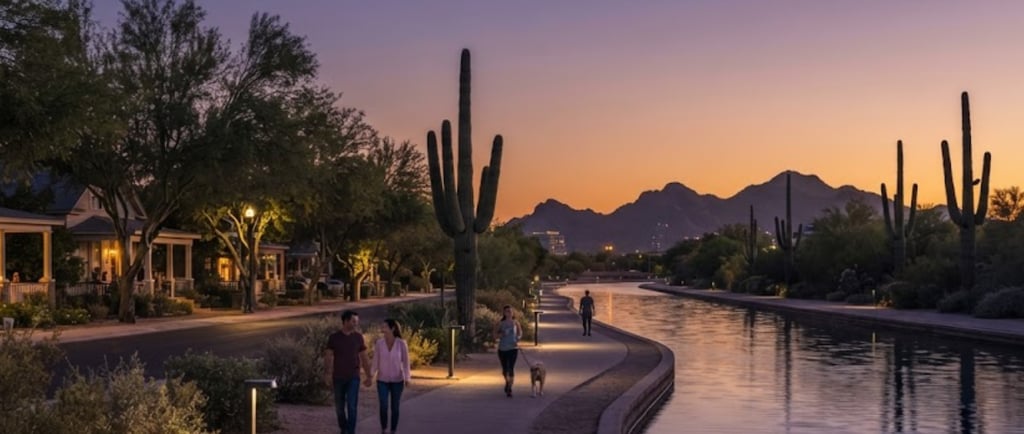
The Evening Walk
Disclosure: This article has sponsored content produced in partnership with our brand partners.
By mid-summer in the Phoenix Valley, the daytime world operates like a pressure cooker. Asphalt radiates a punishing heat, swimming pools turn into lukewarm bathwater, and the mere act of walking to the mailbox feels like an endurance sport. For months, the sun dictates our lives with autocratic severity. We scuttle from air-conditioned homes to air-conditioned cars, sealing ourselves behind tinted glass and double-paned windows.
Yet, there is a distinct, communal shift that happens just past eight o'clock. While most of the world is settling in front of the television set, we challenge you to get up and get out.
As the bruised violet hues of twilight finally swallow the copper glare of the desert sky, something ancient and deeply human takes place across our neighborhoods. Porch lights flicker on. Front doors swing open. Screen doors creak. The Valley, having held its breath for twelve grueling hours, exhales.
This is the magic hour—or rather, the series of precious, cooling hours—that belongs to the evening walker. And in a landscape dominated by sprawl and suburban isolation, reclaiming the evening walk is nothing short of a radical act of community connection.
The Physics and Psychology of the Valley Twilight
To understand why the evening walk feels so restorative in Arizona, you have to look past the simple drop in the thermometer. Yes, the ambient temperature might finally slide down from a scorching one-hundred-and-fourteen to a relatively merciful eighty-eight degrees, but the psychological relief is far more profound.
Daytime summer in the desert is defined by a sense of siege. The environment feels adversarial; nature is something to protect yourself against. But nighttime in the Sonoran Desert is an entirely different ecosystem. The air loses its sharp, biting edge. A faint, dry breeze—often carrying the scent of irrigated oleander, creosote after a distant monsoon, or blooming night-cereus—begins to stir. Maybe you will stroll past one of our beloved neighborhoods with scented orange groves.
When you step out onto the pavement after dark, your nervous system undergoes an immediate decompression. The glaring, horizontal light of day is replaced by the soft, amber glow of porch lamps and the canopy of a surprisingly bright desert sky. Walking in this environment forces you out of your digital silos. Without the tyranny of notifications or the glare of a laptop screen, your focus narrows to the rhythmic crunch of gravel underfoot, the silhouette of towering saguaros against the horizon, and the faint hum of neighborhood life around you.
Navigating the Valley After Dark: Where to Walk
Not all evening routes are created equal. Surviving and thriving in the Valley’s summer nights requires knowing where the microclimates work in your favor.
1. The Urban Canals: Phoenix’s Liquid Corridors
If you want the ultimate evening walking experience in the Valley, look for the water. The Salt River Project (SRP) canal system—stretching across Phoenix, Scottsdale, Tempe, and Glendale—serves as the circulatory system of our desert oasis.
Walking along the Grand Canal or the Arizona Canal after sunset reveals a hidden metropolis. Because water retains thermal mass differently than concrete, the air directly adjacent to the canals often carries a subtle, cooling draft. More importantly, these multi-use paths are pedestrian sanctuaries. Free from car traffic, you will cross paths with cyclists, dog walkers, runners, and fellow evening strollers. It is a shared public commons where a quick nod or a "good evening" to a stranger breaks the quiet solitude of the path.
2. Pocket Neighborhoods and Mature Suburbs
If you live in an older Valley neighborhood—think mid-century pockets of Mesa, central Phoenix, or historic Glendale—you possess a goldmine for evening exploration. These areas boast something modern developments often lack: mature, canopy-forming shade trees like Palo Verdes, Mesquites, and giant Ficus trees.
During the day, these trees provide vital shade; by night, they trap a pocket of slightly cooler, earthier air close to the ground. Walking through these neighborhoods feels intimate. You catch the rich aromas of backyard barbecues, hear the soft splash of children still lingering in backyard pools, and notice the eclectic personality of front-yard landscaping that gets washed out in the blinding midday sun.
3. Local Parks and Community Greenspaces
Municipal parks across the Valley—from Gilbert’s expansive Riparian Preserve to Steele Indian School Park in central Phoenix—transform entirely after dark. While the daytime playgrounds sit vacant and ghost-like under the sun, the paved perimeter loops become social hubs as the stars come out. Families push strollers, teenagers chat on benches, and neighbors catch up on the day’s events away from the noise of arterial roads.
The Valley, having held its breath for twelve grueling hours, exhales.
The Lost Art of the Porch Culture
You cannot talk about the evening walk without talking about the infrastructure that supports it: the front porch.
For decades, suburban design across America committed a quiet architectural sin by turning houses away from the street. Garages migrated to the front and center, swallowing the facade, while living spaces retreated to private, walled-off backyards. We effectively engineered our neighborhoods to discourage spontaneous social contact.
Yet, during the peak of the Phoenix summer, a fascinating grassroots rebellion occurs. Driven by the desire for fresh air, homeowners drag chairs down to their front driveways, sit on low courtyard walls, or utilize small front porches.
When you make a habit of walking your neighborhood regularly after dark, you become a familiar fixture of the landscape. The first few nights, you might just exchange polite waves. By the second week, those waves turn into brief weather commiserations ("Think it’ll drop below ninety tonight?"). By month’s end, you’re standing at the end of someone’s driveway for twenty minutes, discussing local politics, swapping garden tips on how to keep your citrus trees alive through the heat wave, or hearing stories about how the neighborhood used to look twenty years ago.
This is the antidote to modern isolation. It requires no apps, no RSVP, and no scheduled zoom calls. It is organic, low-stakes, and deeply rooted in physical proximity.
Practical Wisdom for the Desert Night Stroller
If you are looking to integrate the evening walk into your summer routine, a little desert-smart preparation goes a long way.
Timing is Everything: Aim for the window between 8:30 PM and 10:00 PM. This allows the asphalt just enough time to release a fraction of its daytime heat, while still giving you plenty of time to enjoy the calm before the stillness of midnight.
Spray Bottle: If you are truly an avid Phoenician walker you will learn that when the daily temperatures hit north of 110-degrees it makes a walk much less enjoyable without a mister. Even at night the temperature stays elevated. You can pick up a simple mister on sites like Amazon.
Hydration Doesn't Stop at Sunset: Even though the sun is down, the desert air remains exceptionally dry. Keep a small handheld water bottle or camelbak with you, especially if you are embarking on longer canal stretches.
Embrace the Local Wildlife: Remember that you are sharing the dusk with desert fauna. Bats swooping overhead to feed on mosquitoes are your best friends. Keep an eye out for desert toads near irrigated lawns, and give coyotes or javelinas plenty of respectful space if you encounter them on the canal banks.
Leave the Earbuds at Home: To truly experience the evening, let go of the podcast or playlist for at least half of your walk. Listen to the rustle of palm fronds, the distant chime of wind chimes, and the rare, beautiful quiet that settles over the Valley once the traffic thins out.
Reclaiming Our Place in the Valley
Living in the desert requires a constant negotiation with the elements. We spend half the year bracing ourselves, adjusting our thermostats, and hiding indoors. It is easy to let that bunker mentality bleed into our social lives, making us strangers to the very people living fifty feet away from us.
The evening walk is our reclamation project. It is an invitation to step outside the air-conditioned box, embrace the warmth of the summer night on our terms, and remember that a community isn't built on sprawling master-planned designs alone. It is built one slow, deliberate step at a time, under the vast, starlit canopy of the Arizona sky.
Recent Articles
Daily Phoenix © 2026
Daily Phoenix is Arizona’s premium digital magazine for faith‑forward leadership, community resilience, and local governance.
Reframe your inbox
Subscribe to our newsletter and never miss a story.
We care about your data in our privacy policy.